19 May 2007 04:21 SOMALIA WATCH |
| SW News | ||||||||||||||||||||||||
__________________________________________________________________________________
Somaliland
radio says 18 people died in Djibouti mutiny
BBC Monitoring Service - United Kingdom; Dec 8, 2000 Text of report by Somaliland's Hargeysa radio on 8th December Reports concerning last night's clashes in Djibouti say destruction was widespread and that lives and property was lost. Tension is also still high in the city. A report received this evening from our reporter in Loyada [along Djibouti-Somaliland border] said the death toll which includes soldiers and civilians stands at 18. Eighty four people who included police officers and civilians who supported the activities of Gen Yabeh were arrested last night. According to our reporter, Mr Abubakar Hasan Abdi, it has been confirmed that the wife of Gen Yabeh and six policemen were arrested when they surrendered to the minister of labour of that country who handed them over to the interim prime minister... The reports say there were many deaths in Artida [phonetic] estate which houses Djibouti police barracks. Source: Radio Hargeysa, Voice of the Republic of Somaliland, in Somali 1700 gmt 8 Dec 00 ____________________________________________________________________________________
Friday, 8 December,
2000, 12:44 GMT
Djibouti rebel police officers arrested
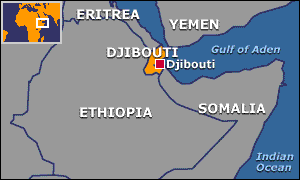
Djibouti authorities say they have arrested all police officers
who staged a rebellion on Thursday expect police chief General
Yacin Yabeh who is holed up in a foreign embassy.
But the government did not name the embassy or say how many people had been arrested. Armed policemen surrounded the presidency on Thursday morning after President Ismael Omar Guelleh sacked Mr Yabeh as the chief of staff of the National Police Force. No reason was given for the dismissal. In a statement issued on Friday, the government said "the perpetrators of this small-scale rebellion have been arrested except for General Yacin Yabeh who has taken refuge at a foreign embassy." The government said the situation had returned to normal after the disturbances which left two people dead and six others wounded. French troops Witnesses said the Djibouti army put down the revolt after a nearly 45 minute shoot-out with the police.
Witnesses said the streets of Djibouti were quiet on Friday - a non-working day in the predominantly Muslim state. A French military officer speaking from Paris said the policemen had abandoned their positions after a few shots were fired. "It looks like it was a fit of pique by the police because their boss was sacked. It's also possible that clan rivalries were involved," the officer told Reuters. French troops based in Djibouti were confined to their bases during the trouble, he said. Good friends Many people assumed that the president and his police chief were good friends because they grew up together. But tension between the two is reported to have been growing. One report said President Guelleh had accused the police chief of not being in control of security in the capital. Colonel Ali Hasan Omar was named as the new interim head of the police. __________________________________________________________________________________
Witnesses Describe "Coup Attempt"
UN Integrated Regional Information Network December 8, 2000
Calm returned to Djibouti on Friday after a police rebellion took hold of the city for a few hours, over the sacking of their chief on the previous day. After a brief shoot-out between a hard-core group of officers loyal to the former chief, General Yacin Yabeh Gaab, and the army, the government said order had been restored. Two people were killed in the shoot-out, and six injured, according to the government. The first indication of the rebellion was around midday (local time), when police cut off all access to the presidency. A stand-off between the group of police loyal to General Yacin and the paramilitary gendarmerie, brought Ramadan-subdued Djibouti city to a standstill until about 3 pm, a local journalist who witnessed the events told IRIN in a telephone interview. The administrative centre was sealed off, though the religious month of Ramadan meant there was little normal transaction and movement in the Muslim city. "It was an eerie spectacle. I couldn't believe my eyes and ears," said the journalist. Two police ambulances were used to broadcast a message of rebellion, inviting people to gather at two locations. "I saw one of the ambulances criss-crossing the city, blaring out from its public address system: "The tyrant has been overthrown, General Yacin is president." Another group of about 12 police officers took over the official radio and television station, Radio Television Djibouti (RTD), which is in the same vicinity as the president's office. In a broadcast, then, the public was called to converge at the Sheik Osman army camp, which is the armoured section of the Djibouti barracks in town, or in front of the presidency where the stand-off between the police and gendarmerie continued. Witnesses say it was attempt to hinder the army in its response. Despite the broadcast, only a small group of people, including plainclothes police officers, responded. The reaction of most Djiboutians was surprise and curiosity, said witnesses. "I saw some policemen trying to incite some young men onto the streets, but the boys just looked bewildered and clapped their hands," said the local journalist. There was "no mood for rebellion" apparent, he told IRIN. At about 2 pm local time, the police occupying RTD released a message, in Somali (Djiboutians speak both Somali and French), which local journalists translated to IRIN as: "The people of Djibouti have liberated themselves, because the president has abandoned them." The message included accusations of corruption, and declared that President Ismail Omar Guelleh lacked authority. The two-minute message had little impact, however, because few people were listening to the radio. "It was put out at a time when nothing had been on air for hours, and when people were busy with Ramadan," a local journalist explained. But the message, combined with the declaration over the public address system of General Yacin's takeover as president, were considered "hallmarks" of an attempted coup d'etat, said the journalist. The first shoot-out took place at about 4.15 pm and around RTD, between the army on the one hand and the police holding the radio and television station on the other hand. It lasted for about 15 minutes, after which the army overpowered the police. Witnesses say this was the first sign of army involvement. "Then the army moved in with at least a couple of tanks and there was panic, with everyone running in all directions for cover," said the journalist, who was watching events around the radio and television station. Journalists from RTD were persuaded, after the shoot-out, to restore normal broadcasting, despite their ordeal. Described by local journalists who reached them first as "shaken, bewildered and tired", the RTD staff had been held at gunpoint. "They told me they had been threatened at gunpoint by police officers, who were nervous and giving irrational orders to move from one room to another," a local journalist told IRIN. They were forced at gunpoint to broadcast the rebellion message. Normal broadcasts and scheduled programmes returned at about 5 pm, including a message from Interior Minister Abdullah Abdullahi Miguil. He relayed the first government message, at about 5.15 pm, which said Djibouti had returned to normal, that authority had been restored throughout the country, and thanked the Djibouti people for not heeding the message of the "coup plotters". similar message was relayed later by the Communications Minister Rifti Abdulkadir. As the messages were being broadcast, the army was taking control of Djibouti telecommunication, which had also been taken over by police loyal to General Yacin. Djibouti telephone lines were cut off from the rest of the world from about 3 pm to about 11 pm on Thursday. Another shoot-out took place at the main police barracks, which are situated about two km south of the city on the road to Arta, local journalists said.Opposition sources said the rebellion began when police followed the orders of General Yacin, national police chief since independence, in refusing to accept President Guelleh's decision to sack him, news agencies said. The decision was made on Monday, and publicly broadcast on Thursday morning. He is replaced by Colonel Ali Hasan Omar, who was reportedly able to persuade a number of officers to abandon the attempted rebellion. Ill-feeling has been brewing over General Yacin's position since Guelleh was elected president in 1999. "It has been rumoured since Guelleh's appointment that General Yacin would go, and be given an ambassadorship or ministry," Djibouti political sources told IRIN. Guelleh and General Yacin are longtime friends. Both were born in Dire Dawa, Ethiopia, were students together, and returned to Djibouti before independence from France in June 1977. Guelleh came back, was made a police inspector during the colonial period, and then sacked because of his pro-independence views. He went on to become one of former President Guled Aptidon's closest aides, and head of state security. Yacin, meanwhile, remained head of the police force, an appointment made at independence. General Yacin was "very upset" at his dismissal, but may not have organised the rebellion, one Djibouti source told IRIN. He was known to be a tough man with a hardcore following of intensely loyal officers. He has been given refuge at "a foreign embassy", government sources said. This is believed to have been the French Embassy. "Many people saw it as a stand-off between two former friends. There was no real mood for rebellion in Djibouti," a local witness told IRIN. Nairobi, 8 December 2000. [ News] |
||||||||||||||||||||||||