Crude Designs:
The Rip-Off of Iraq’s Oil Wealth
By Greg Muttitt
PLATFORM
with
Global Policy Forum,
Institute for Policy Studies (New Internationalism Project)
New Economics Foundation
Oil
Change International and
War on
Want
November 2005
For pdf version, click
here
Acknowledgements
Researched and written by Greg Muttitt of
PLATFORM www.carbonweb.org, with assistance from Guy Hughes
and Katy Cronin of Crisis Action www.crisisaction.org.uk.
Advice on economic modelling provided by
Dr Ian Rutledge of Sheffield Energy & Resources Information
Services (SERIS) www.seris.co.uk
Published by PLATFORM with Global Policy
Forum, Institute for Policy Studies (New Internationalism
Project), New Economics Foundation, Oil Change International
and War on Want - November 2005.
Design by Guy Hughes
www.power-shift.org.uk. Cover design by Ishka Michocka
www.lumpylemon.co.uk.
Printed by Seacourt Press on recycled
paper (75% post-consumer waste) using a waterless process in
compliance with ISO 14001 and EMAS.
Contents
Back to top
Executive Summary
Glossary
Chapters:

1 - The ultimate prize:
Anglo-American interests in Gulf oil
2 - Re-thinking
privatisation: Production sharing agreements
3 - Pumping
profits: Big Oil and the push for PSAs
4 - From
Washington to Baghdad: Planning Iraq's oil future
5 - Contractual
rip-off: the cost of PSAs to Iraq
6 - A better deal:
Options for investment in Iraqi oil
7 - Conclusion
Appendices:
1 - How a Production
Sharing Agreement works
2 - Discounting in
oilfield economics – key concepts
3 - Iraqi oilfield data
4 - Economic analysis -
methodology and assumptions
References
About the publishers
List of tables:
5.1 - Impact of PSAs on Iraqi state
revenues
5.2 - Impact of PSAs
on discounted Iraqi state revenues
5.3 - Impact of PSAs
on Iraqi revenues at different oil prices
5.4 - Impact of PSAs
on oil company profitability
5.5 - Oil company
profitability at different oil prices
6.1 - Foreign
investment in the world’s major oil reserves
A3.1 - Data on 25
undeveloped Iraqi oilfields
Executive Summary
Back to top
While the Iraqi people struggle to define
their future amid political chaos and violence, the fate of
their most valuable economic asset, oil, is being decided
behind closed doors.
This report reveals how an oil policy
with origins in the US State Department is on course to be
adopted in Iraq, soon after the December elections, with no
public debate and at enormous potential cost. The policy
allocates the majority (1)
of Iraq’s oilfields – accounting for at least 64% of the
country’s oil reserves – for development by multinational
oil companies.
Iraqi public opinion is strongly opposed
to handing control over oil development to foreign
companies. But with the active involvement of the US and
British governments a group of powerful Iraqi politicians
and technocrats is pushing for a system of long term
contracts with foreign oil companies which will be beyond
the reach of Iraqi courts, public scrutiny or democratic
control.
COSTING IRAQ BILLIONS
Economic projections published here for
the first time show that the model of oil development that
is being proposed will cost Iraq hundreds of billions of
dollars in lost revenue, while providing foreign companies
with enormous profits.
Our key findings are:
At an oil price of $40 per barrel, Iraq stands to lose
between $74 billion and $194 billion over the lifetime of
the proposed contracts (2),
from only the first 12 oilfields to be developed. These
estimates, based on conservative assumptions, represent
between two and seven times the current Iraqi government
budget.
Under the likely terms of the contracts, oil company
rates of return from investing in Iraq would range from 42%
to 162%, far in excess of usual industry minimum target of
around 12% return on investment.
A CONTRACTUAL RIP-OFF
The debate over oil “privatisation” in
Iraq has often been misleading due to the technical nature
of the term, which refers to legal ownership of oil
reserves. This has allowed governments and companies to deny
that “privatisation” is taking place. Meanwhile, important
practical questions, of public versus private control over
oil development and revenues, have not been addressed.
The development model being promoted in
Iraq, and supported by key figures in the Oil Ministry, is
based on contracts known as production sharing agreements
(PSAs), which have existed in the oil industry since the
late 1960s. Oil experts agree that their purpose is largely
political: technically they keep legal ownership of oil
reserves in state hands (3),
while practically delivering oil companies the same results
as the concession agreements they replaced.
Running to hundreds of pages of complex
legal and financial language and generally subject to
commercial confidentiality provisions, PSAs are effectively
immune from public scrutiny and lock governments into
economic terms that cannot be altered for decades.
In Iraq’s case, these contracts could be
signed while the government is new and weak, the security
situation dire, and the country still under military
occupation. As such the terms are likely to be highly
unfavourable, but could persist for up to 40 years.
Furthermore, PSAs generally exempt
foreign oil companies from any new laws that might affect
their profits. And the contracts often stipulate that
disputes are heard not in the country’s own courts but in
international investment tribunals, which make their
decisions on commercial grounds and do not consider the
national interest or other national laws. Iraq could be
surrendering its democracy as soon as it achieves it.
POLICY DELIVERED FROM AMERICA TO IRAQ
Production sharing agreements have been
heavily promoted by oil companies and by the US
Administration.
The use of PSAs in Iraq was proposed by
the Future of Iraq project, the US State Department’s
planning mechanism, prior to the 2003 invasion. These
proposals were subsequently developed by the Coalition
Provisional Authority, by the Iraq Interim Government and by
the current Transitional Government. The Iraqi Constitution
also opens the door to foreign companies, albeit in legally
vague terms.
Of course, what ultimately happens will
depend on the outcome of the elections, on the broader
political and security situation and on negotiations with
oil companies. However, the pressure for Iraq to adopt PSAs
is substantial. The current government is fast-tracking the
process and is already negotiating contracts with oil
companies in parallel with the constitutional process,
elections and passage of a Petroleum Law.
The Constitution also suggests a
decentralisation of authority over oil contracts, from the
national level to Iraq’s regions. If implemented, the
regions would have weaker bargaining power than a national
government, leading to poorer terms for Iraq in any deal
with oil companies.
A RADICAL DEPARTURE
In order to make their case, oil
companies and their supporters argue that PSAs are standard
practice in the oil industry and that Iraq has no other
option to finance oil development. Neither of these
assertions is true.
According to International Energy Agency
figures, PSAs are only used in respect of about 12% of world
oil reserves, in countries where oilfields are small (and
often offshore), production costs are high, and exploration
prospects are uncertain. None of these conditions applies to
Iraq.
None of the top oil producers in the
Middle East uses PSAs. Some governments that have signed
them regret doing so. In Russia, where political upheaval
was followed by rapid opening up to the private sector in
the 1990s, PSAs have cost the state billions of dollars,
making it unlikely that any more will be signed. The
parallel with Iraq's current transition is obvious.
The advocates of PSAs also claim that
obtaining investment from foreign companies through these
types of contracts would save the government up to $2.5
billion a year, freeing up funds for other public spending.
Although this is true, the investment by oil companies now
would be massively offset by the loss of state revenues
later.
Our calculations show that were the Iraqi
government to use PSAs, its cost of capital would be between
75% and 119%. At this cost, the advantages referred to are
simply not worth it.
Iraq has a range of less damaging and
expensive options for generating investment in its oil
sector. These include: financing oil development through
government budgetary expenditure (as is currently the case),
using future oil flows as collateral to borrow money, or
using international oil companies through shorter-term, less
restrictive and less lucrative contracts than PSAs
(4).
IN WHOSE INTERESTS?
PSAs represent a radical redesign of
Iraq's oil industry, wrenching it from public into private
hands. The strategic drivers for this are the US/UK push for
“energy security” in a constrained market and the
multinational oil companies’ need to “book” new reserves to
secure future growth.
Despite their disadvantages to the Iraqi
economy and democracy, they are being introduced in Iraq
without public debate.
It is up to the Iraqi people to decide
the terms for the development of their oil resources. We
hope that this report will help explain the likely
consequences of decisions being made in secret on their
behalf.
Notes
1. The Iraqi government would be left
with control of only the 17 fields that are already in
production, out of around 80 known fields.
2. The precise terms of proposed
contracts are obviously be subject to negotiation: our
projections are based on a range of terms used in the most
comparable countries, including Libya, which is commonly
viewed as having some of the most stringent in the world.
Multinational oil companies are pushing for lucrative terms
by international standards, based on Iraq’s high level of
political and security risk. These risks place the Iraqi
government in an extremely weak negotiating position. The
projections are given in undiscounted real terms (2006
prices). The contract duration is assumed to be 30 years as
25-40 years is the common length. The (2006) net present
value of the loss to Iraq amounts to between $16 billion and
$43 billion at 12% discount rate.
3. The terminology of PSAs labels the
private companies as “contractors”. This report illustrates
that this label is misleading because PSAs give companies
control over oil development and access to extensive
profits.
4. These might include buyback contracts,
risk service contracts or development and production
contracts
Glossary
Back to top
Bbl barrels
bn billion
CEO Chief Executive Officer
CNPC China National Petroleum
Corporation
CPA Coalition Provisional
Authority
DOE (US) Department of Energy
DPC development and
production contract
FCO (UK) Foreign and
Commonwealth Office
FDI foreign direct investment
FOB freight on board
GDP gross domestic product
ICSID International Centre
for Settlement of Investment Disputes
IMF International Monetary
Fund
INOC Iraq National Oil
Company
IOC international oil company
IPC Iraq Petroleum Company
ITIC International Tax and
Investment Centre
IRR internal rate of return
kbpd thousand barrels per day
KRG Kurdistan Regional
Government
mbd million barrels per day
MEES Middle East Economic
Survey
MOU memorandum of
understanding
OECD Organisation for
Economic Co-operation and Development
OPEC Organisation of
Petroleum Exporting Countries
NPV net present value
PSA production sharing
agreement
SERIS Sheffield Energy and
Resources Information Service
UN United Nations
USAID United States Agency
for International Development
1. The Ultimate Prize:
Anglo-American interests in Gulf oil
Back to top
The UK and US have long had their eyes on
the massive energy resources of Iraq and the Gulf. In 1918
Sir Maurice Hankey, Britain’s First Secretary of the War
Cabinet wrote:
“Oil in the next war will occupy the
place of coal in the present war, or at least a parallel
place to coal. The only big potential supply that we can
get under British control is the Persian [now Iran] and
Mesopotamian [now Iraq] supply… Control over these oil
supplies becomes a first class British war aim.”(1)
After World War II both the US and UK
identified the importance of Middle Eastern oil. British
officials believed that the area was “a vital prize for any
power interested in world influence or domination”(2),
while their US counterparts saw the oil resources of Saudi
Arabia as a “stupendous source of strategic power and one of
the greatest material prizes in world history”(3).
TURNING BACK TO THE MIDDLE EAST
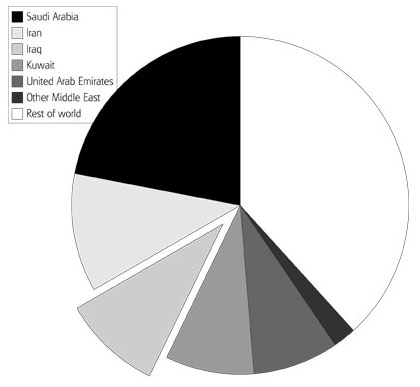
With over 60% of the world’s oil
reserves,(4) their
interest in the Gulf region is unsurprising. Iraq alone has
the third largest oil reserves on the planet – accounting
for 10% of the world total. Iraq is also reckoned to have
the world’s largest unexplored potential, primarily in the
Western Desert. On top of its 115 billion barrels of proven
reserves, Iraq is estimated to have between 100 and 200
billion barrels of further possible (as yet undiscovered)
reserves. Furthermore, not only are Iraqi and Gulf reserves
huge, they are mostly onshore, in favourable reservoir
structures, and extractable at extremely low cost.
Since the nationalisation of the major
oil industries of the Middle East in the 1970s, Gulf
reserves have been out of the direct control of the West and
off the balance sheets of its companies. The oil companies
have filled the gap by moving into the North Sea and Alaska
in the 1970s and 1980s, and then in the 1990s by opening new
‘frontier’ areas such as the Caspian Sea and offshore West
Africa.
However, the North Sea and Alaska are now
in decline and while companies continue to actively pursue
frontier oil development, the opportunities for growth there
are limited and costs high. Thus, unable to escape from the
arithmetic of where the giant reserves are, the US and UK
are turning back their attention to the Middle East.
In a speech to the Institute of Petroleum
in London in 1999, Dick Cheney, then CEO of oil services
company Halliburton, commented:
“By 2010 we will need on the order of
an additional fifty million barrels a day. So where is
the oil going to come from? ... While many regions of
the world offer great oil opportunities, the Middle East
with two thirds of the world's oil and the lowest cost,
is still where the prize ultimately lies.”(5)
To this analysis, he added a note of
frustration: “Even though companies are anxious for greater
access there, progress continues to be slow”.
A PRIMARY FOCUS OF US/UK ENERGY
POLICY
Two years later, one of the Bush
Administration’s first actions was to appoint Cheney, as US
Vice President, to lead an Energy Task Force to consider
where the USA’s long-term energy supplies would come from.
His report noted:
“By any estimation, Middle East oil
producers will remain central to world oil security. The
Gulf will be a primary focus of U.S. international
energy policy.”(6)
While US interest in Middle Eastern oil
has been well-documented, similar considerations play in
British strategic planning too. In January 2003, Foreign
Secretary Jack Straw announced that one of the Foreign
Office’s seven priorities was “to bolster the security of
British and global energy supplies”.(7)
The geography of such a policy had been spelled out in the
1998 Strategic Defence Review white paper:
“Outside Europe our interests are
most likely to be affected by events in the Gulf and the
Mediterranean. Instability in these areas also carries
wider risks. We have particularly important national
interests and close friendships in the Gulf. Oil
supplies from the Gulf are crucial to the world
economy.”(8)
Pointing to the government’s partnership
on these issues with major oil companies, a further Foreign
Office strategy paper later in 2003 identified a key
objective as to:
“improve investment regimes and
energy sector management in these regions [the Middle
East, parts of Africa and the former Soviet Union],
focusing on key links in the supply chain to the
UK”(9)
(emphasis added).
Importantly, these policies in America
and Britain are coordinated. The US-UK Energy Dialogue - a
bilateral initiative established during the April 2002
meeting of Prime Minister Blair and President Bush in
Crawford, Texas(10),
and designed to “enhance coordination and cooperation on
energy issues” - demonstrates the close convergence of
Anglo-American views and interests on Middle Eastern oil:
“Current forecasts for the oil sector
put global demand by 2030 at about 120 million barrels
per day (mbd), which is roughly 45 mbd higher than
today. While recognizing that the increasing role of
Russia and other non-OPEC producers, a large proportion
of the world's additional demand will likely be met by
the Middle East (mainly Middle East Gulf) producers.
They hold over half of current proven reserves,
exploration and production costs are the lowest in the
world, and production in many mature fields in the OECD
area is likely to fall. To meet future world energy
demand, the current installed capacity in the Gulf
(currently 23 mbd) may need to rise to as much as 52 mbd
by 2030.”(11)
PUSHING FOREIGN INVESTMENT
However, as noted in the Dialogue, one
obstacle to “free access” to oil that concerns the British
and Americans is the lack of ‘installed extraction
capacity’. To help deal with this problem President Bush and
Prime Minister Blair tasked a joint Working Group with a
list of planned activities. First on the list was to
undertake “...a targeted study to examine the capital and
investment needs of key Gulf countries...”.(12)
Within this context, it is perhaps
unsurprising that in advising on the post-war reconstruction
of Iraq, the British government has recommended that foreign
investment in oilfields of most benefit to Iraq. In late
summer 2004, the Foreign and Commonwealth Office issued a
Code of Practice for the Iraqi oil industry, which argued
that:
“It has been estimated that a minimum
of US$ 4 billion would be needed to restore production
to its 1990 levels of 3.5 million barrels per day (mbd),
and perhaps US$ 25 billion to achieve 5 mbd. ... Given
Iraq's needs, it is not realistic to cut government
spending in other areas, and Iraq would need to engage
with the International Oil Companies (IOCs) to provide
appropriate levels of Foreign Direct Investment (FDI) to
do this.”(13)
| |
|
| |
Photo: Greg Muttitt
The key US-UK "energy security" priority is secure
control over an increasing supply of Gulf oil,
preferably delivered by investment from their own
companies |
The Foreign Office subsequently went on
to advise the Ministry of Oil on “fiscal and regulatory”
issues.(14)
Although this was never published in a formal policy
document, it continued at an informal level, with Foreign
Office minister Kim Howells stating that “We discuss with
the Iraqi Ministries their priorities on a regular basis.”(15)
The FCO remains secretive about the content of this advice,
refusing Freedom of Information applications. Tellingly, one
of the exemptions used for their refusal was that the advice
was “voluminous”.(16)
The US government too has maintained
close contacts with Iraqi decision-makers.(17)
Speaking on the handover from the Coalition Provisional
Authority to the Iraqi Interim Government, one senior US
official said:
“We're still here. We'll be paying a
lot of attention and we'll have a lot of influence.
We're going to have the world's largest diplomatic
mission with a significant amount of political weight."(18)
A report commissioned by the US Agency
for International Development was more specific about the
form of contracts that should be used in Iraq, in order to
achieve the West’s energy security goals:
“Using some form of [production
sharing agreements] with a competitive rate of return
has proved the most successful way to attract
[international oil company] investment to expand oil
productive capacity significantly and quickly.”(19)
As the above policies illustrate, the key
US-UK ‘energy security’ priority is secure control over an
increasing supply of Gulf oil, preferably delivered by
investment from their own oil companies. It is clear that
Iraq's newly accessible oil is expected to play an important
role in meeting these priorities. But as we shall see,
implementing these arrangements could have severe impacts on
Iraq’s future development.
2. Re-thinking
privatisation: Production sharing agreements
Back to top
THE NATURE OF "PRIVATISATION"
Given the West’s fundamental strategic
interest in the oil reserves of Iraq and the Gulf as
outlined in the previous section, some observers were
surprised when the oil sector was excluded from the sweeping
privatisations of Iraq’s economy by US Administrator Paul
Bremer in 2003 and 2004. Decisions on the future structure
of the oil industry were deferred, to be addressed by an
elected Iraqi government.
The Coalition Provisional Authority only
awarded short-term repair and restoration contracts – for
service companies such as Halliburton and Parsons to restore
the country’s existing oil infrastructure, which had been
damaged by war and sanctions – rather than long-term
extraction concessions. In February 2005, Interim Oil
Minister Thamer al-Ghadban stated that "As for the
extraction sector, that is, dealing with the oil and gas
reserves, which are 'assets', privatisation is completely
out of the question at the moment."(20)
But if the non-privatisation of oil was a
surprise, this was largely based on a misconception of what
“privatisation” means in the Iraqi context. In the minds of
some neo-conservatives, writing on Iraqi oil before the war,
privatisation meant the transfer of legal ownership of
Iraq's oil reserves into private hands. However, in all
countries of the world except the USA
(a), reserves (prior to their
extraction) are legally the property of the state. This is
the case in Iraq, and remains so under the new Constitution.
There has never been a realistic prospect of US-style
privatisation of Iraq’s oil reserves. But this does not mean
that private companies would not develop Iraq’s oil.
In some ways, the debate on
“privatisation” has obscured the important practical issues
of who gets the revenue from the oil, and
who controls the way in which oil is
developed. On this matter, Iraq has a relevant history.
The development of Iraq’s oil industry
began in the aftermath of the First World War, while the
country was occupied by Britain under a League of Nations
Mandate. In 1925, Iraq’s British-installed monarch, King
Faisal, signed a concession contract with the Iraq Petroleum
Company (IPC)(21),
a consortium of British, French and (later) American oil
companies. The contract followed a model widely applied in
the British colonies. It was for a period of 75 years,
during which terms were frozen. Combined with two further
concessions granted in the 1930s, the IPC obtained rights to
all of the oil in the entire country. Even the Iraqi call
for a 20% stake in the concession was denied, despite having
been specified in earlier agreements.
As Iraqi frustration at the unfair terms
of the deal grew, in the 1950s and 1960s the contract came
under pressure. Underpinning this were the issues of whether
the split of revenues between company and state was a fair
one, and the degree of control the foreign companies had
over the development: they restricted production to boost
their producing areas elsewhere in the world, and used their
monopoly on information to fix prices, depriving Iraq of
income. These same arguments were echoed in all of the major
oil-producing countries at the time, most of which had
similar deals with multinational companies. The ultimate
conclusion to these disputes was the nationalisation of many
oil industries – in Iraq’s case in two stages in 1961 and
1972.(b)
INTRODUCING PRODUCTION SHARING
AGREEMENTS
While these disputes were raging in the
Middle East, a different model was emerging in Indonesia.
There, a new form of contract was introduced in the late
1960s: the production sharing agreement (PSA).
An ingenious arrangement, PSAs shift the
ownership of oil from companies to state, and invert the
flow of payments between state and company. Whereas in a
concession system, foreign companies have rights to the oil
in the ground, and compensate host states for taking their
resources (via royalties and taxes), a PSA leaves the oil
legally in the hands of the state, while the foreign
companies are compensated for their investment in oil
production infrastructure and for the risks they have taken
in doing so.
Although many in the oil industry were
initially suspicious of Indonesia’s move, they soon realised
that by setting the terms the right way, a PSA could deliver
the same practical outcomes as a concession, with the
advantage of relieving nationalist pressures within the
country. In one of the standard textbooks on petroleum
fiscal systems, industry consultant Daniel Johnston
comments:
“At first [PSAs] and concessionary
systems appear to be quite different. They have major
symbolic and philosophical differences, but these serve
more of a political function than anything else. The
terminology is certainly distinct, but these systems are
really not that different from a financial point of
view.”(22)
So, the financial and economic
implications of PSAs may be the same as concessions, but
they have clear political advantages – especially when
contrasted with the 1970s nationalisations in the Middle
East. Professor Thomas Wälde, an expert in oil law and
policy at the University of Dundee, describes them as:
“A convenient marriage between the
politically useful symbolism of the production-sharing
contract (appearance of a service contract to the state
company acting as master) and the material equivalence
of this contract model with concession/licence regimes
in all significant aspects…The government can be seen to
be running the show - and the company can run it behind
the camouflage of legal title symbolising the assertion
of national sovereignty.”(23)
As we will see, these advantages now
appear to make PSAs the Western method of choice for future
development of the Iraqi oil industry.
OPTIONS FOR OIL POLICY
There are essentially three
models a country may choose from for the
structure of its oil industry, plus a number of
variations on these themes.
1. The system currently in
place in Iraq, which has been the case since the
early 1970s, is a NATIONALISED INDUSTRY.
In this model, the state makes all of the
decisions, and takes all of the revenue. The
extent of involvement of foreign private
companies is that they might be hired to carry
out certain services under contract (a
technical service contract) – a well-defined
piece of work, for a limited period of time, and
for which they receive a fixed fee. This is the
model used throughout most of the Gulf region.
One variant on the technical
service contract is the risk service contract.
In this system, a private company provides
capital to invest in a project, but is paid a
fixed rate of return, agreed in the contracts
(thus preventing excessive profits). A similar
mechanism is the buyback contract, which
has been used on some fields in Iran, in which
companies also have a right to buy the oil or
gas.
2. In the CONCESSION
model, sometimes known as the tax and royalty
system, the government grants a private company
(or more often, a consortium of private
companies) a license to extract oil, which
becomes the company’s property (to sell,
transport or refine) once extracted. The company
pays the government taxes and royalties for the
oil.
3. The PRODUCTION SHARING
AGREEMENT (PSA) is a more complex system. In
theory, the state has ultimate control over the
oil, while a private company or consortium of
companies extracts it under contract. In
practice, however, the actions of the state are
severely constrained by stipulations in the
contract. In a PSA, the private company provides
the capital investment, first in exploration,
then drilling and the construction of
infrastructure. The first proportion of oil
extracted is then allocated to the company,
which uses oil sales to recoup its costs and
capital investment – the oil used for this
purpose is termed ‘cost oil’. There is usually a
limit on what proportion of oil production in
any year can count as cost oil. Once costs have
been recovered, the remaining ‘profit oil’ is
divided between state and company in agreed
proportions. The company is usually taxed on its
profit oil. There may also be a royalty payable
on all oil produced.
Sometimes the state also
participates as a commercial partner in the
contract, operating in joint venture with
foreign oil companies as part of the consortium
– with either a concession or a PSA model. In
this case, the state generally provides its
percentage share of development investment and
directly receives the same percentage share of
profits.
|
3. Pumping profits: Big
Oil and the push for PSAs
Back to top
As with many issues of foreign policy,
the interests of the world’s largest oil corporations mesh
closely with those of their national governments – as we saw
in section 1. While the governments seek secure and adequate
supplies of oil to feed their economies, the corporations
need control over reserves to ensure their future
profitability, to deliver returns to their shareholders. For
governments, “secure” oil supplies often means that they are
in fact part-controlled by major oil corporations based in
their own countries.
For their part, major multinational oil
companies have made no secret of their desire to gain access
to Iraq’s reserves. Shortly before the invasion Archie
Dunham, chairman of US oil major ConocoPhillips, explained
that “We know where the best [Iraqi] reserves are [and] we
covet the opportunity to get those some day.”(24)
Shell has stated that it aims to “establish a material and
enduring presence in the country.”(25)
Since the overthrow of Saddam Hussein,
foreign oil companies have worked hard to build
relationships with Iraq’s Oil Ministry. They have appointed
lobbyists to develop relationships with influential
officials, provided training (often for free) for Iraqi
officials and technicians, sponsored Oil Ministry
participation in international conferences, and entered
contracts (again, often for free) to analyse oilfield
geological data.
In 2004, Shell recruited an Iraqi
external affairs officer to help the company gain access to
Iraqi government decision-makers, specifying in their
advertisement:
“A person of Iraqi extraction with
strong family connections and an insight into the
network of families of significance within Iraq”.(26)
Through these means, the companies aim to
be well-positioned when it comes to the signing of
contracts.
WHAT OIL COMPANIES WANT
It is helpful at this point to look at
the companies’ agenda for Iraq. Oil corporations are looking
for three things when they invest in a country, all of which
are delivered by production sharing agreements:
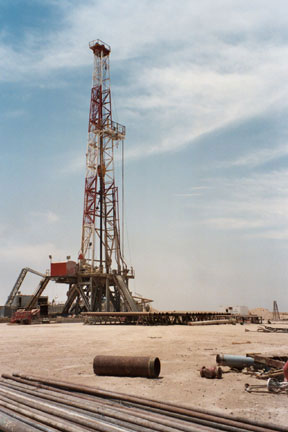 |
Photo: Greg Muttitt
Oil companies covet Iraq's oil wealth, and are
pushing for access to it through production sharing
agreements |
1. A right to oil reserves.
Companies want a deal that guarantees their right to extract
the reserves for many years, thus ensuring their future
growth and profits. Furthermore, they want a contract that
allows them to ‘book’ these reserves – including them in
their accounts – which increases their company value.
Production sharing agreements, like concession contracts,
permit companies to book reserves in their accounts. The
importance of this should not be underestimated for the oil
majors. In 2004, when British/Dutch oil company Shell was
found to have overstated the size of its ‘booked’ reserves
by over 20%, it lost the faith of the financial markets:
this impacted heavily on its share price and credit rating.
Shell is now desperate to acquire new reserves – which is a
key reason why Shell has made more effort than most to make
friends in Iraq.
2. An opportunity to make large
profits. Generally, oil companies make their profits
from investing and risking their capital. In some cases,
they lose their capital, for example when they drill a ‘dry
well’. But in some cases they will find large and hugely
profitable fields. Oil companies are therefore very
different from service companies like Halliburton, which
make money from fixed fees on predictable contracts. Oil
companies aim for deals which may be more speculative, but
which give them a chance of making super-profits. Production
sharing agreements are designed to allow companies to
achieve very large profits if successful.
3. Predictability of tax and
regulation. While companies can accept exploration risk
(that they won’t find oil) or price risk (that the oil price
falls), both being beyond their control, they try to manage
‘political risk’ (that tax or regulatory demands will
increase) by locking in governments. They thus seek to bind
governments into long-term contracts that fix the terms of
their investment. Production sharing agreements generally
last for 25 to 40 years with terms protected from potential
change by incoming governments.
Shell’s head of Exploration & Production,
speaking at a conference in 2003, made the case for PSAs:
“...international oil companies can
make an ongoing contribution to the region [the
Persian/Arabian Gulf]... However, in order to secure
that investment, we will need some assurance of future
income and, in particular, a supportive contractual
framework. There are a number of models which can
achieve these ends. One option is the greater use of
production sharing agreements, which have proved very
effective in achieving an appropriate balance of
incentives between Governments and oil companies. And
they ensure a fair distribution of the value of a
resource while providing the long term assurance which
is necessary to secure the capital investment needed for
energy projects.”(27)
THE VOICE OF BIG OIL
The most detailed expression of what the
oil companies are seeking in Iraq has been made by the
International Tax & Investment Centre (ITIC), a corporate
lobby group pushing for pro-business investment and tax
reform.
Almost all of ITIC's 110 listed sponsors
are large corporations, with roughly a quarter of these in
the oil sector. ITIC’s Board of Directors contains
representatives from Shell, BP, ConocoPhillips, ExxonMobil
and ChevronTexaco. Since its launch in 1993, ITIC has
primarily focused on the former Soviet Union, but more
recently, it has expanded its work to include Iraq. Its 2004
strategy review concluded that this project “should be
continued and considered as a “beachhead” for possible
further expansion in the Middle East.”(28)
In autumn 2004 ITIC issued a major report
entitled Petroleum and Iraq's Future: Fiscal Options and
Challenges, which includes the following key
recommendations:
“The most appropriate legal and fiscal form for the
facilitation of [Foreign Direct Investment] longer-term
development of Iraq's petroleum industry will be a
production sharing agreement (PSA).”(29)
Foreign Direct Investment, by ITIC members and other
multinational oil companies, would “effectively “kick start”
the [Iraqi] economy and avoid the government diverting
spending to oil development that is sorely needed for other
programmes.”(30)
PSAs are lauded as providing the
“simplest and most attractive regulatory ... framework”
which the ITIC claims are now the “norm in most countries
outside the OECD.”(31)
Having reviewed the various options, with due consideration
to “international experience and regional preferences”, the
ITIC concludes that the alternative models are far inferior
to PSAs.
INAPPROPRIATE FOR IRAQ
PSAs are indeed quite common in countries
with small oil reserves and/or high extraction costs
(especially from offshore fields) and/or high exploration or
technical risks. However, none of these conditions apply to
Iraq; in fact, Iraq is quite the opposite. PSAs are not
found in any other country comparable to Iraq.
It is difficult to overstate how radical
a departure PSAs would be from normal practice, both in Iraq
and in other comparable countries of the region. Iraq’s oil
industry has been in public hands since 1972; prior to that
the rights to develop oil in 99.5% of the country had also
been publicly held since 1961.(c)
In Iraq’s neighbours Kuwait, Iran and
Saudi Arabia, foreign control over oil development is ruled
out by constitution or by national law. These countries
together with Iraq are the world’s top four countries in
terms of oil reserves, with 51% of the world total between
them.(32)
Together with the United Arab Emirates,
Venezuela and Russia, seven countries hold 72% of the
world’s oil reserves. These latter three all have some
foreign involvement through concession agreements, although
both Venezuela and Russia are currently drawing back from
it, following unsuccessful expansions in foreign investment
in the 1990s. Of these seven countries with major oil
reserves, only Russia has any production sharing agreements.
Russia signed three PSAs in the mid 1990s; however, PSAs
have been the subject of extreme controversy ever since, due
to the poor deal the state has obtained from them, and it
now looks unlikely that any more will be signed.
Countries with reserves the size of
Iraq’s do not use PSAs because they do not need to and are
able to run their oil industries on far more beneficial
terms.
4. From Washington to
Baghdad: Planning Iraq's oil future
Back to top
PRE-INVASION PLANNING
| |
 |
| |
Current Iraqi oil policy - first designed in
Washington, DC - would give at least 4% of Iraq's
reserves to foreign companies |
Prior to the 2003 invasion, the principal
vehicle for planning the new post-war Iraq was the US State
Department’s Future of Iraq project. This initiative,
commencing as early as April 2002, involved meetings in
Washington and London of 17 working groups, each comprised
of 10-20 Iraqi exiles and international experts selected by
the State Department(33).
The “Oil and Energy” working group met
four times between December 2002 and April 2003. Although
the full membership of the group has never been revealed, it
is known that Ibrahim Bahr al-Uloum, the current Iraqi Oil
Minister, was a member.(34)
The 15-strong oil working group concluded that Iraq “should
be opened to international oil companies as quickly as
possible after the war” and that “the country should
establish a conducive business environment to attract
investment of oil and gas resources.”(35)
The subgroup went on to recommend
production sharing agreements (PSAs) as their favoured model
for attracting foreign investment. Comments by the
handpicked participants revealed that “many in the group
favoured production-sharing agreements with oil companies.”
Another representative commented, “Everybody keeps coming
back to PSAs.”(36)
The reasons for this choice were
explained in the formal policy recommendations of the
working group, published in April 2003:
“Key attractions of production
sharing agreements to private oil companies are that
although the reserves are owned by the state, accounting
procedures permit the companies to book the reserves in
their accounts, but, other things being equal, the most
important feature from the perspective of private oil
companies is that the government take is defined in the
terms of the [PSA] and the oil companies are therefore
protected under a PSA from future adverse legislation.”(37)
The group also made it clear that in
order to maximize investments, the specific terms of the
PSAs should be favourable to foreign investors:
“PSAs can induce many billions of
dollars of foreign direct investment into Iraq, but only
with the right terms, conditions, regulatory framework,
laws, oil industry structure and perceived attitude to
foreign participation.”(38)
Recognising the importance of this
announcement, The Financial Times noted:
“Production-sharing deals allow oil
companies a favourable profit margin and, unlike royalty
schemes, insulate them from losses incurred when the oil
price drops. For years, big oil companies have been
fighting for such agreements without success in
countries such as Kuwait and Saudi Arabia.”(39)
The article concluded that: “The move
could spell a windfall for big oil companies such as
ExxonMobil, Royal Dutch/Shell, BP and TotalFinaElf...”
SHAPING THE NEW IRAQ
The US and UK have worked hard to ensure
that the future path for oil development chosen by the first
elected Iraqi government will closely match their interests.
So far it appears they have been highly successful:
production sharing agreements, which were first proposed by
the U.S. State Department group, have emerged as the model
of oil development favoured by all the post-invasion phases
of Iraqi government.
Phase 1: Coalition Provisional
Authority and Iraqi Governing Council
During the first fourteen months
following the invasion, occupation forces had direct control
of Iraq through the Coalition Provisional Authority.
Stopping short of privatising oil itself, the CPA began
setting up the framework for a longer-term oil policy.
The CPA appointed former senior
executives from oil companies to begin this process. The
first advisers were appointed in January 2003, before the
invasion even started, and were stationed in Kuwait ready to
move in. First, there were Phillip Carroll, formerly of
Shell, and Gary Vogler, of ExxonMobil, backed up by three
employees of the US Department of Energy and one of the
Australian government. Carroll described his role as not
only to address short-term fuel needs and the initial repair
of production facilities, but also to:
“Begin planning for the restructuring of the Ministry of
Oil to improve its efficiency and effectiveness; [and]
Begin thinking through Iraq’s strategy options for
significantly increasing its production capacity.”(40)
In October 2003, Carroll and Vogler were
replaced by Bob McKee of ConocoPhillips, and Terry Adams of
BP, and finally in March 2004, by Mike Stinson of
ConocoPhillips and Bob Morgan of BP
(d). The £147,700 cost of the two
British advisers, Adams and Morgan, was met by the UK
government.(41)
Following the handover to the Iraq Interim Government in
June 2004, Stinson became an adviser to the US Embassy in
Baghdad.
On 13 July 2003, in the first move
towards Iraqi self-government, the CPA Administrator Paul
Bremer appointed the quasi-autonomous, but virtually
powerless, Iraqi Governing Council. On the same day Bremer
appointed Ibrahim Bahr al-Uloum, who had been a member of
the U.S. State Department oil working group, as Minister for
Oil.
Within months of his appointment Bahr
al-Uloum announced that he was preparing plans for the
privatisation of Iraq's oil sector, but that no decision
would be taken until after elections scheduled for 2005.(42)
Speaking to the Financial Times, Bahr
al-Uloum, a US-trained petroleum engineer, said: "The Iraqi
oil sector needs privatisation, but it's a cultural issue,”
noting the difficulty of persuading the Iraqi people of such
a policy. He then proceeded to announce that he personally
supported:
Production sharing agreements for upstream (i.e.
extraction of crude oil) development;
giving priority to US oil companies, “and European
companies, probably.”(43)
Phase 2: Iraq Interim Government
In June 2004, the CPA formally handed
over Iraqi sovereignty to an interim government, headed by
Prime Minister Iyad Allawi.
The position of Minister of Oil was
handed to Thamir al-Ghadban, a UK-trained petroleum engineer
and former senior adviser to Bahr al-Uloum. In an interview
in Shell’s in-house magazine, al-Ghadban announced that 2005
would be the “year of dialogue” with multinational oil
companies.(44)
About three months after taking power,
Allawi issued a set of guidelines to the Supreme Council for
Oil Policy, from which the Council was to develop a full
petroleum policy. Pre-empting both the Iraqi elections and
the drafting of a new constitution, Allawi’s guidelines
specified that while Iraq’s currently producing fields
should be developed by the Iraq National Oil Company (INOC),
all other fields should be developed by private companies,
through the contractual mechanism of production sharing
agreements (PSAs).(45)
Iraq has about 80 known oilfields, only
17 of which are currently in production. Thus the Allawi
guidelines would grant the other 63 to private companies.
Allawi also added that:
New fields would be developed exclusively by private
companies, with the policy ruling out any participation of
INOC;(46)
The national oil company INOC, which manages existing
oil fields, should be part-privatised;(47)
The Iraqi authorities should not spend time negotiating
the best possible deals with the oil companies; instead they
should proceed quickly, agreeing whatever terms the
companies will accept, with a possibility of renegotiation
(e) later.(48)
Phase 3: Transitional Government and
writing the Constitution
The interim government was replaced in
early 2005 by the election of Iraq's new National Assembly,
which led to the formation of the new government with
Ibrahim al-Ja’afari as Prime Minister. In a move which no
doubt assisted policy continuity from the period of US
control, Ibrahim Bahr al-Uloum was reappointed to the
position of Minister for Oil.
Meanwhile, Ahmad Chalabi, the Pentagon’s
former favourite to run Iraq, was appointed chair of the
Energy Council, which replaced the Supreme Council for Oil
Policy as the key overseer of energy and oil policy. Back in
2002 Chalabi had famously promised that “US companies will
have a big shot at Iraqi oil.”(49)
By June 2005, government sources reported
that a Petroleum Law (f)
had been drafted, ready to be enacted after the
December elections. According to the sources – although some
details are still being debated – the draft of the Law
specifies that while Iraq’s currently producing fields
should be developed by INOC, new fields should be developed
by private companies.
In October 2005, a new Constitution was
accepted in a referendum of the Iraqi population. Like much
of the Constitution, the oil policy section is open to some
interpretation. Apparently referring to fields not currently
in production, it states:
“The federal government and the
governments of the producing regions and provinces
together will draw up the necessary strategic policies
to develop oil and gas wealth to bring the greatest
benefit for the Iraqi people, relying on the most modern
techniques of market principles and encouraging
investment.”(50)
There are two issues here. The reference
to “market principles and encouraging investment” indicates
a clear direction of travel, in terms of opening to private
companies. Meanwhile the first part of this clause, somewhat
vaguely, tries to deal with the issue of jurisdiction.
However, while this states that the federal and regional
governments will work together, a subsequent clause states
that:
“All that is not written in the
exclusive powers of the federal authorities is in the
authority of the regions. In other powers shared between
the federal government and the regions, the priority
will be given to the region's law in case of dispute.”(51)
Signing of contracts for extraction of
oil and other natural resources is not listed(52)
as one of the exclusive powers of the federal authorities –
the implication is thus that on new fields, it is the
authority of the regional governments.
This situation is quite unclear, and is
further muddied by a last-minute deal, arranged just before
the constitutional referendum, that the Constitution could
be amended in the first half of 2006, and by comments by
Zalmay Khalilzad, US Ambassador to Iraq, that “after that,
as Iraq evolves, so, too, will this charter evolve”.(53)
In so far as the decision rests with
Baghdad, the Oil Ministry is keen to sign contracts as
quickly as possible. According to officials in the Ministry,
their aim is to begin signing long-term contracts with
foreign oil companies during the first nine months of 2006.(54)
In order to achieve this goal, officials wanted to start
negotiations with oil companies during the second half of
2005, before a legitimate Iraqi government is elected and in
parallel with the writing of a Petroleum Law.(55)
This time frame means that contracts will be negotiated
without public participation or debate, or proper legal
framework.
Meanwhile, the Kurdish authorities are
even more impatient to sign deals. In June 2004, the
Kurdistan Regional Government (KRG) signed an exploration
and development deal with Norwegian company DNO. In a clear
sign of the tensions between Baghdad and the regions, the
Oil Ministry reacted by warning companies that if they
signed deals with regional governments, they would be
excluded from contracts at a national level.
Then in October 2005, the KRG signed a
memorandum of understanding (MOU) with K Petroleum Company,
which is jointly owned by the Canada-based Heritage Oil and
the Kurdish company Eagle, to carry out oilfield studies
adjacent to the Taq Taq field in Kurdistan. Announcing the
deal, Heritage stated that
“Negotiations to formalize the MOU
into a Production Sharing Agreement(PSA) are scheduled
to commence while the work program is being carried
out.KPC is confident these studies will translate into a
PSA, although there is no guarantee that a license will
be awarded to the Company.”(56)
For the southern oilfields, the outlook
is less clear. In any case, regional governments of both
Kurdistan and southern Iraq would have far weaker bargaining
power in negotiating with foreign oil companies than the
Iraqi Oil Ministry (or Iraq National Oil Company), as they
lack both the institutional experience and the consolidated
weight of handling the entire country’s resources. The
likely result would be more negative terms than could be
achieved at a national level.
As noted above, only 17 of Iraq’s 80
known fields are currently in production.(57)
As these 17 fields represent only 40 billion of Iraq's 115
billion barrels of known oil reserves, the policy to
allocate undeveloped fields to foreign companies would give
those companies control of 64% of known reserves.(58)
If a further 100 billion barrels are found, as is widely
predicted, the foreign companies could control as much as
81% of Iraq's oil; if 200 billion are found, as the Oil
Ministry predicts, the foreign company share would be 87%.
Given that oil accounts for over 95% of
Iraq’s government revenues(59),
the impact of this policy on Iraq’s economy would be
enormous.
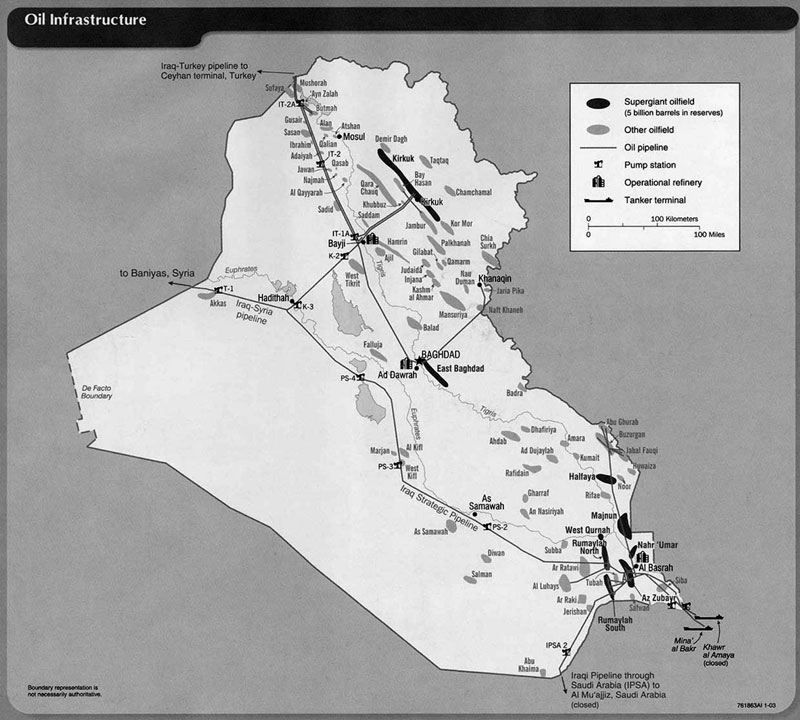
|
Map of Iraqi oil fields
and pipelines
|
 |
|
Map: University
of Texas Libraries
|
5. Contractual rip-off:
The cost of PSAs to Iraq
Back to top
While the advantages of production
sharing agreements for multinational oil companies are
clear, there is a severe shortage of independent analysis of
whether PSAs are in the short, medium and long-term
interests of the Iraqi people. Unfortunately the Iraqi
people have not been informed of the pro-PSA oil development
plans, let alone their implications, which have transformed
so seamlessly from US State Department recommendations into
Iraqi government policy. This report hopes to go some way
towards redressing this balance.
Our analysis shows that production
sharing agreements have two major disadvantages for the
Iraqi people:
1. The loss of hundreds of billions of
dollars in potential revenue;
2. The loss of democratic control of
Iraq's oil industry to international companies;
PSAs may also undermine an important
opportunity to establish effective public oversight and end
the current corruption and financial mismanagement in the
Iraqi oil sector (see Section 6).
PSAs generally last (with fixed terms)
for between 25 and 40 years: thus once signed the Iraqi
people would have to live with the consequences for decades.
LOSING REVENUE: HOW MUCH WOULD PSAS
COST THE IRAQI PEOPLE?
In order to understand why foreign oil
companies are so keen to invest in Iraq, one needs to look
at the economic outcomes that would result from applying PSA
contracts to the Iraqi oil sector.
We have produced economic models of 12 of
Iraq’s oilfields that have been listed as priorities for
investment under production sharing agreements. We do not
know yet what terms Iraqi contracts might contain (that will
not be known until they are signed – and possibly not at
all, if they are not disclosed to the public). Therefore we
have taken contractual terms used in other comparable
countries, and applied them to the physical characteristics
of Iraq’s oilfields (based on data from the Iraqi Oil
Ministry, the US Government and respected industry analysts
such as Deutsche Bank – see Appendix 3).
This process allows us to project the cashflows to the Iraqi
state and to foreign oil companies, under a range of
assumptions (such as oil price).
Specifically, we look at terms used in
Oman and Libya (both having comparable physical conditions
to Iraq) and Russia (the only country with any PSAs which
has reserves at all comparable in scale to Iraq’s). The
terms recently applied in Libya are widely viewed to be
among the most stringent in the world. We have then compared
the results with expected revenues of a nationalised system,
administered by state-owned oil companies.(g)
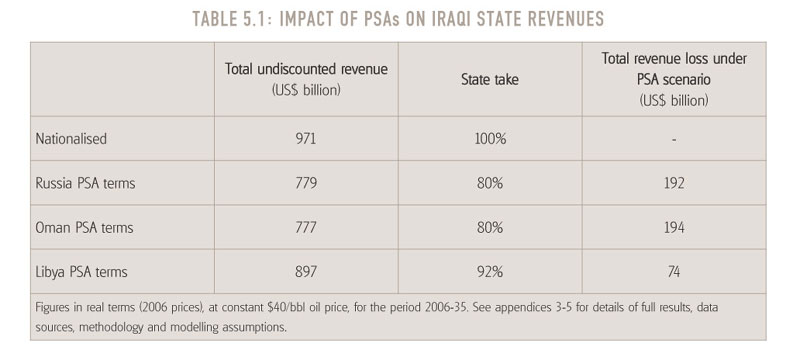
Using an average oil price of $40 per
barrel, our projections reveal that the use of PSAs would
cost Iraq between $74 billion and $194 billion in lost
revenue, compared to keeping oil development in public
hands.
This massive loss is the equivalent of
$2,800 to $7,400 per Iraqi adult over the thirty-year
lifetime of a PSA contract. By way of comparison Iraqi GDP
currently stands at only $2,100 per person, despite the very
high oil price.(60)
It should be noted that these figures
relate to only 12 of Iraq’s more than 60 undeveloped fields.
Iraq has identified 23 priority fields on which to
potentially sign contracts in 2006.(h)
Thus when the other 11 fields are added, along with a
further 35 or more later, and especially other fields yet to
be discovered (recall that Iraq’s undiscovered reserves may
be as large or even double the known reserves), the full
cost of the PSA policy could be considerably greater.
We have been deliberately conservative
with our assumptions. Our assumptions and methodology are
outlined in Appendix 4.
Both the corporate lobby group ITIC (see
section 3) and the British Foreign
Office have argued that foreign investment can free up Iraqi
government budgets for other priority areas of spending, to
the tune of around $2.5 billion a year.(61)
Although technically true, this is deeply misleading – as
the investment now would be offset by the loss of revenues
later.
Amazingly, in ITIC’s report advocating
the use of PSAs, the economic impact is only examined up to
2010(62) – ignoring
the fact that any foreign investment must be repaid.(j)
It is as if one took out a bank loan but only considered the
economic impact prior to paying it back!
|
|
|
Photo: Greg
Muttitt
The use of PSAs could deprive Iraq of $190
billion of revenue
|
In contrast, in this report, we look at
the impact of PSAs over the whole length of the contract.
Economists and indeed oil companies compare investments
using the process of ‘discounting’, and the concept of ‘net
present value’ (NPV). NPV is a measure of what the later
income or expenditure would be worth if they were received
or incurred now (See Appendix 2).
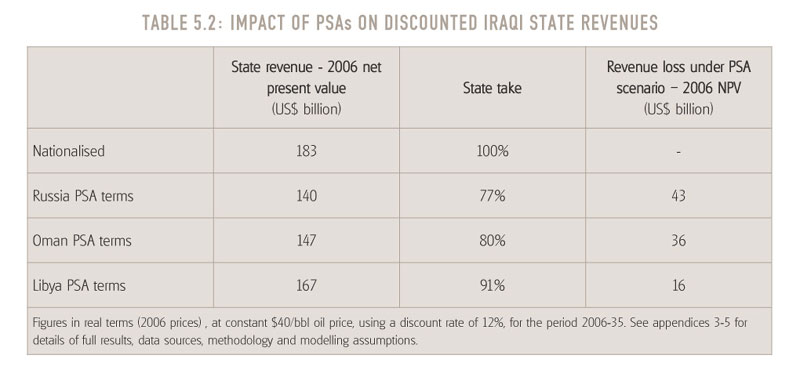
When looked at in these terms, far from
‘saving’ the government $8.5 billion of investment (the
whole investment over several years, in 2006 NPV), these
contracts will cost Iraq a (2006) NPV of $16 - $43 billion,
at a 12% discount rate.(k)
Our assumed oil price for these
calculations is $40 per barrel. The oil price is currently
fluctuating around $60 per barrel, and there is an argument
that structural factors, such as increasing demand in China
and India, mean that oil prices are likely to stay at this
level – which would make our $40 assumption conservative.
However, the oil price is notoriously
difficult to predict. We therefore also look at the models
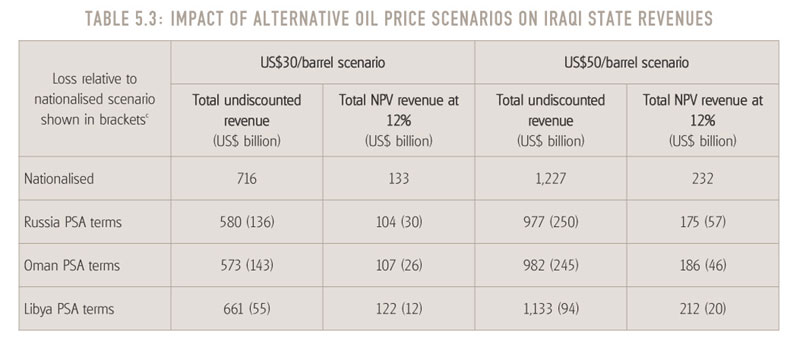
at a higher price of $50 and a lower price of $30 per
barrel. Here the models show that Iraq would lose $55 to
$143 billion at $30 per barrel, while if the oil price
averaged a higher $50 per barrel, Iraq would lose far
greater revenues of $94 - $250 billion, compared to the
nationalised model.
MASSIVE PROFITS: HOW MUCH DO THE OIL
COMPANIES STAND TO GAIN?
Our economic model has also been used to
calculate the key measure of oil project profitability - the
Internal Rate of Return (IRR) (see Appendix 2)
- which the oil companies are expected to make. This
provides another measure of whether PSAs represent a fair
deal for Iraq.
Profitability varies according to the
size of the oil field, so we have based our projections on
three different fields which (in Iraqi terms) are typical
small, medium and large oil fields.
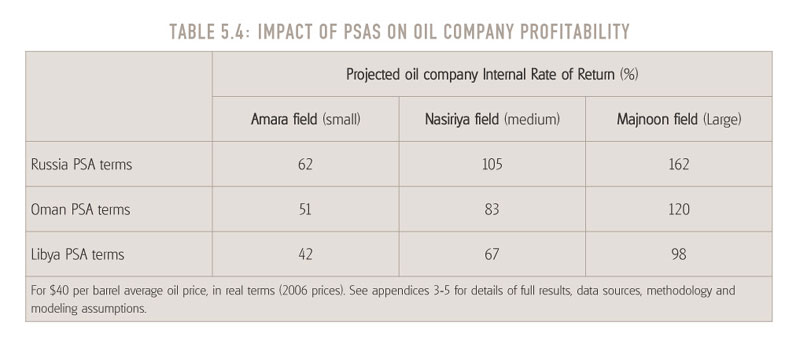
Our figures show that under any
of the three sets of PSA terms, oil company profits from
investing in Iraq would be quite staggering, with annual
rates of return ranging from 42% to 62% for a small field,
or 98% to 162% for a large field. This shows that
under PSAs, Iraq's loss in terms of government revenue will
be the oil companies’ gain.
By way of comparison, oil companies
generally consider any project that generates an IRR of more
than a 12% to be a profitable venture. For Iraqi oil fields,
even under the most stringent PSA terms, it is clear that
the oil companies can expect to achieve stellar returns.
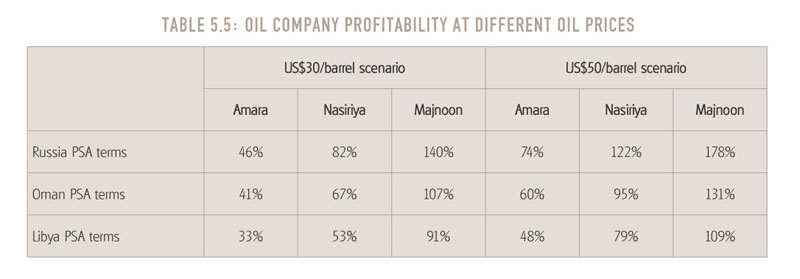
Even at prices of $30/barrel, profits are
excessive on all fields, with any terms, ranging from 33% on
a small field with stringent terms to 140% on a large field
with lucrative terms. At $50/barrel, the profits are even
greater, ranging from 48% to 178%.
LOSING CONTROL: THE DEMOCRATIC COST OF
PSAS
Iraq's democracy is new and weak. Having
suffered decades of oppression by Saddam Hussein, Iraq's
institutions and civil society need time to develop and
mature. In this situation many Iraqis may feel that they do
not wish to immediately lock their country into any
single model of oil development over the long term.
Unfortunately this is exactly what Iraqi politicians, under
US and UK pressure, appear to want to do.
As we saw in
section 2, in theory PSAs would allow the Iraqi state to
retain ownership and control over their oil resources.
However, in practice they will impose severe restrictions on
current and future Iraqi governments for the full lifetime
(25-40 years) of the contract.
PSAs have four key features that will in
practice limit and remove democratic control from the Iraqi
people:
They fix terms for 25-40 years, preventing future
elected governments from changing the contract. Once a
deal is signed, its terms are fixed. The contractual terms
for the following decades will be based on the bargaining
position and political balance that exists at the time of
signing – a time when Iraq is still under military
occupation and its governmental institutions are weak. In
Iraq’s case, this could mean that arguments about political
and security risks in 2006 could land its people with a poor
deal that long outlasts those risks and is completely
unsuited to a potentially more stable and independent Iraq
of the future.
Secondly, they deprive governments of control over
the development of their oil industry. PSA contracts
generally rule out government influence over oil production
rates.(63) As a
result, Iraq would not be able to control the depletion rate
of its oil resources – as an oil-dependent country, the
depletion rate is absolutely key to Iraq’s development
strategy, but would be largely out of the government’s
control. Unable to hold back foreign companies’ production
rates, Iraq would also be likely to have difficulty
complying with OPEC quotas which would harm Iraq’s position
within OPEC, and potentially the effectiveness of OPEC
itself. The only way to avoid either of these two problems
would be for Iraq to cut back production on the fields
controlled by state-owned oil companies, reducing revenues
to the state.
Thirdly, they generally over-ride any future
legislation that compromises company profitability,
effectively limiting the government's ability to regulate.
One of the most worrying aspects of PSAs is that they often
contain so-called ‘stabilisation clauses’, which would
immunise the 60-80% of the oil sector covered by PSAs from
all future laws, regulations and government policies. Put
simply, under PSAs future Iraqi governments would be
prevented from changing tax rates or introducing stricter
laws or regulations relating to labour standards, workplace
safety, community relations, environment or other issues.
One common way of doing this is for contracts to include
clauses that allocate the 'risks' for such tax or
legislative change to the state.(64)
In other words, if the Iraqis decided to change their
legislation, they would have to pick up the bill themselves.
The foreign oil company's profits are effectively
guaranteed.
Fourthly, PSAs commonly specify that any disputes
between the government and foreign companies are resolved
not in national courts, but in international arbitration
tribunals which will not consider the Iraqi public interest.
Within these tribunals, such as those administered by
the International Center for Settlement of Investment
Disputes in Washington DC, or by the International Chamber
of Commerce in Paris, disputes are generally heard by
corporate lawyers and trade negotiators who will only
consider the narrow commercial issues and who will disregard
the wider body of Iraqi law. As the researcher Susan
Leubuscher comments, “That system assigns the State the role
of just another commercial partner, ensures that
non-commercial issues will not be aired, and excludes
representation and redress for populations affected by the
wide-ranging powers granted [multinationals] under
international contracts.”(65)
They may also – especially if connected to bilateral
investment treaties – make a foreign company’s home state a
party to any dispute, thus enabling that country to weigh in
on the company’s behalf.
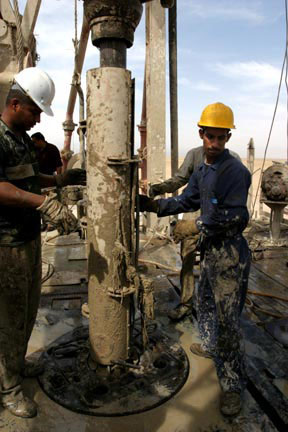 |
Photo: Greg Muttitt
Under PSAs, Iraq would hand
sovereignty over oil resources, to foreign
companies and international investment courts |
This loss of democratic control is
illustrated by the case of BP’s Baku-Tbilisi-Ceyhan
(BTC) oil pipeline, which is being built from the
Caspian Sea to the Mediterranean. This project is
governed by a Host Government Agreement, some of whose
legal provisions are comparable to those in PSAs.
In November 2002, the Georgian
Environment Minister said she could not approve the
pipeline routing through an important National Park, as
to do so would violate Georgia’s environmental laws.
Both BP and the US government put pressure on the
Minister, through then President Shevardnadze. The
Minister was forced first to concede the routing with
environmental conditions, and then to water down her
conditions. Part of the reason for her weak bargaining
position was that two years earlier Georgia had signed
the Host Government Agreement for the project, which set
a deadline for environmental approval within 30 days of
the application and stipulated that the contract had a
higher status than other Georgian laws. The environment
laws the Minister referred to were irrelevant.
Ultimately, on the day of the deadline, the President
called the Minister into his office, and kept her there
until she signed, in the early hours of the morning.(6)
Shortly after Shevardnadze was
overthrown in a ‘rose revolution’ in November 2003, new
President Mikhail Sakashvili commented, “We got a
horrible contract from BP, horrible”(67)
– but he could not change it.
MULTINATIONAL COMPANIES FAVOUR
COMPLEXITY
Another feature of production sharing
agreements is that they are the most contractually
complex form of oil contract. PSAs generally consist of
several hundred pages of technical legal and financial
language (often treated as commercially confidential).
It is their complexity, not their simplicity, which is
advantageous to oil companies.
The simplest form of oil fiscal
system is the royalty (defined as a percentage of the
total value of the oil), which can be seen as a company
paying the state for its oil – effectively ‘buying’ it.
This is used in most concession agreements, and
sometimes in PSAs. In comparison with production sharing
formulae, it is very clear what the state should receive
from royalties – a fixed percentage of the value of oil.
As long as the number of barrels extracted is known, and
the oil price, it is easy to work out what royalty is
due from the oil companies.
However oil companies dislike
royalties and prefer systems based on an assessment of
profits, such as PSAs. The reason is that they want what
they call ‘upside’ (i.e. opportunities for greater
profits) – ways they can reduce their payments, rather
than being subject to a fixed level of payment for oil
extracted.
Under profit-based systems, revenue
is based on the profit remaining when the oil companies’
production costs have been deducted from the total
revenue. As such, they depend on complex rules for which
costs can be deducted, how capital costs are to be
treated, and so on. The more complicated the system, the
more opportunities there are for a company to maximise
their share of the revenue by sophisticated use of
accountancy techniques. Not only do multinational
companies have access to the world’s largest and most
experienced accountancy companies, they also know their
business in more detail than the state they are working
with. Consequently a more complicated system tends to
give multinationals the upper hand.
For example, in the Sakhalin II
project in Russia, the complex terms of the PSA resulted
in all cost over-runs being effectively deducted from
state revenue instead of from the Shell-led consortium’s
profits. During the planning and early construction of
the project, costs inflated dramatically. In February
2005, the Audit Chamber of the Russian Federation
published a review of the economics of the project,
finding that cost over-runs, due to the terms of the
PSA, had already cost the Russian state $2.5 billion.
Although three PSAs were signed in
the mid 1990s in Russia, they have been the subject of
extreme controversy ever since. The changing view of
PSAs in Russia in general also illustrates the loss of
democratic control inherent in PSAs – if the government
or political climate changes, the terms of a PSA cannot
change to reflect new priorities. PSAs generally last
for between 25 and 40 years. In Russia’s case, the rush
to privatise in the early 1990s is now being questioned
– but with the PSAs already in force it is impossible to
rectify mistakes.
The Sakhalin II PSA is an example of
a special type of PSA, which is growing in prominence.
In such PSAs, the sharing of ‘profit oil’ is based not
on a fixed proportion, but on a sliding scale, based on
the foreign company’s profitability. The state receives
only a low proportion of profit oil (or in the Sakhalin
case, none) until the company has achieved a specified
level of profit. Thus, states are deprived of revenue,
while corporate profits are guaranteed. (See
Appendix 1).
IRAQ WOULD FARE NO BETTER
In theory, Iraq may be able to
negotiate PSAs with much more stringent terms than those
used elsewhere in the world. As noted above, we do not
know what exact terms Iraq might adopt if it uses PSAs.
Iraq could also, in theory, avoid some of the more
draconian legal clauses outlined above.
However, we have also seen that there
are a number of structural features of PSAs which are
likely to act against Iraq’s interests, whatever the
terms. Helmut Merklein, a former senior official of the
US Department of Energy, explains this based on the
concept of economic rents – the excess profits of oil
production (after deducting production costs and a
reasonable return on capital):
“For all the sophistication and
the bells and whistles these contracts have, … they
all have two basic flaws, which make them less than
perfect in terms of capturing rent. They are subject
to distortions through petroleum price fluctuations
in world markets, and they generally fail to provide
the host country with its proper rent if the field
turns out to be greater than expected. Various
triggers in those agreements reduce the host
country’s exposure, but they never really eliminate
it.”(68)
The generation of rents is a feature
of oil production. Because of oil’s sheer value, its
extraction generates profits beyond what is normally
expected on an investment. These rents should belong to
the country that possesses the oil resource. However,
Merklein’s point is that PSAs cannot – in unpredictable
economic circumstances – deliver the country its fair
share of the rents, and inevitably tend to give foreign
oil companies excessive profits at the country’s
expense.
To the flaws identified by Merklein,
we would add the long-term and restrictive nature of
PSAs, that their terms are fixed as negotiated in a
situation which – one hopes – will not persist in Iraq;
and that they also place legal constraints beyond the
issue of revenue-sharing, as we have seen.
In some countries, circumstances in
the oil sector may favour investment through a mechanism
such as PSAs, in spite of these disadvantages – such as
where fields are offshore, risk capital for exploration
is required, or the country lacks technical competence.
In Iraq, however, these conditions do not apply, and
given the country’s huge oil wealth, it does not need to
accept the negative consequences of PSAs.
On top of these structural flaws in
PSAs, there are grounds to doubt whether the specific
terms Iraq might achieve would be any better than in
other countries, despite Iraq’s enormous oil reserves.
The key issue here is bargaining power: the Iraqi state
is new and weak, and damaged by the ongoing violence and
by corruption, and the country is still under military
occupation.
In fact, rather than negotiating a
more stringent PSA deal than elsewhere, the oil
companies will inevitably wish to focus on the current
security situation to push for a deal comparable to – or
better than – that in other countries in the world,
while downplaying the huge reserves and low production
costs which make Iraq an irresistible investment.
Indeed, precisely this point is being
pushed by the oil companies and their governments. The
corporate lobby group ITIC attempts to invert
conventional economic logic, by implying that there is
greater competition among oil-producing countries than
among private companies:
“Although Iraq’s potential
petroleum wealth is enormous, the government still
faces competition from other countries offering
petroleum rights to investors. … Investors, too, are
competing for access to attractive petroleum
deposits but competition among them may be limited
if the project in question requires scarce expertise
or depth of financial resources.”(69)
Thus one of ITIC’s key
recommendations is that Iraq “offer to companies profit
potential consistent with the risk they bear”.(70)
Their argument that countries, not
companies, must compete is especially perverse given the
high oil price, and the wide recognition of supply
constraint: that there is a shortage of access to
reserves, not of access to capital.
Similarly, the US government’s
development agency USAID has advised the Iraqi
authorities that
“Countries with less attractive
geology and governance, such as Azerbaijan, have
been able to partially overcome their risk profile
and attract billions of dollars of investment by
offering a contractual balance of commercial
interests within the risk contract, one that is
enforceable under UK and Azeri law with the option
of international arbitration.”(71)
If Iraq follows that advice, it could
not only concede a contractual form which is not in its
interests, but specific terms which radically understate
the country’s attractiveness to the international oil
industry. Along with much of its future income, Iraq
could be surrendering its democracy as soon as it
achieves it.
6. A better deal:
Options for investment in Iraq’s oil development
Back to top
A central question for Iraqi planners
and politicians is how to invest in the country's
oilfields – revenues from which will provide the central
plank of the Iraqi economy for the foreseeable future.
In the last section we saw, by looking at common
practice elsewhere in the world, that investment through
production sharing agreements (PSAs), would be likely to
come at considerable cost to Iraq.
A RADICAL DEPARTURE
Much as their proponents like to
claim that PSAs are standard practice throughout the
world’s oil industries, in fact International Energy
Agency figures show that just 12% of world oil
reserves are subject to PSAs, compared to 67%
developed solely or primarily by national oil companies.(72)
Thus it is far from inevitable or necessary that PSAs
must be used in order to obtain investment in Iraq’s oil
development.
PSAs are often used in countries with
small reserves; however the nationalised model is almost
exclusively used in all countries with very large oil
reserves.
The use of PSAs in Iraq would
represent a major departure from common practice among
the large oil producers of the region. Iraq and three of
its neighbours (Saudi Arabia, Iran and Kuwait) are the
world’s top four countries in terms of oil reserves,
with 51% of the world total between them.(73)
None of them use any form of foreign company equity
involvement in oilfields.
Looking further afield, these four
Gulf states together with the United Arab Emirates,
Venezuela and Russia, hold 72% of the world’s oil
reserves. These latter three all have some foreign
involvement in their oil industry, although both
Venezuela and Russia are currently drawing back from it,
following unsuccessful expansions in foreign investment
in the 1990s. Of these seven countries with major oil
reserves, only Russia has any production sharing
agreements.
In the Russian case, three PSAs were
signed in the mid 1990s; they have been the subject of
extreme controversy ever since due to the poor deal the
state has obtained from them, and it now looks unlikely
that any more will be signed.
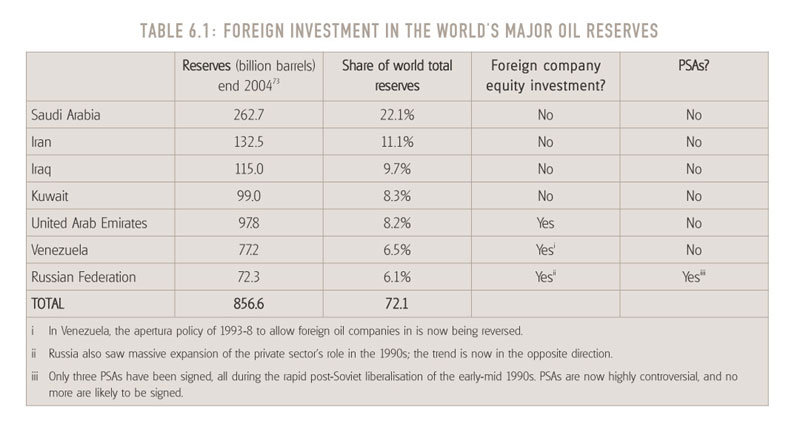
OPTIONS FOR INVESTMENT
One argument that is deployed by
proponents of PSAs is that Iraq has no other option to
generate the capital investment needed to rebuild and
expand its oil industry.
This is simply not true. In fact Iraq
has at least three options for generating investment in
its oil industry, without giving away its revenue and
control over the industry:
1. Direct investment from
government budget.
2. Government / state oil company
borrowing from banks, multilateral agencies and other
lenders.
3. Investment by international oil
companies using more flexible and equitable forms of
contract.
It is not the role of this report to
advocate any particular structure for the Iraqi oil
industry, nor to advocate for or against the use of
foreign investment. That decision rests with the Iraqi
people. However, in this section we briefly explore each
of these options, all three of which are superior to
PSAs in terms of consequences for the Iraqi economy and
people.
|
|
|
Photo:
Greg Muttitt
After 50 years of rip-off by foreign
companies and over 20 years of war, Iraq
needs the right policies to develop its
oil industry.
|
First, it should be stressed that
there is considerable technical competence among Iraqis
themselves and foreign companies are not required to
manage the industry. Indeed, the most successful period
in the history of Iraq’s oil industry was between
nationalisation in 1972 and the start of the first of
Saddam’s wars with Iran in 1980. Freed up from the
foreign interference that had unhappily characterised
Iraq’s previous petroleum history, the Iraq National Oil
Company moved forward confidently and effectively:
between 1970 and 1979, INOC increased production from
1.5 million to 3.7 million barrels per day and
discovered the four super-giant fields West Qurna, East
Baghdad, Majnoon and Nahr Umar, and at least eight giant
fields.
In some areas, the state of Iraqi
knowledge may not be the most up-to-date, because of the
sanctions era. However, this is easily solved within any
of the above models by employing specialist companies
under short-term technical service contracts to provide
drilling and production expertise when required. Thus
what is at issue is how capital is obtained, not skills.
OPTION 1: FINANCING FROM
GOVERNMENT BUDGETS
The simplest model would be for the
required investment to be provided each year out of
government budgets. This is quite possible and
appropriate in Iraq’s case, because in contrast to many
other countries:
The development cost is low when compared to the return;
As a consequence, the payback period is very quick;
Since there are considerable proven but currently
undeveloped oil reserves, risk to capital is very low (as no
exploration is required for immediate field development). In
the longer term, Iraq will explore but even this is
relatively cheap and low-risk.
Iraq's investment requirement is expected
to peak at around $3 billion per year.(75)
This is well within the range of current budgetary
allocations: the 2005 Iraqi oil investment budget is $3
billion76 (out of a total Iraqi budget of around $30
billion).
Furthermore, within at most three years
from the start of development, revenues from new production
would well exceed the ongoing investment requirements, and
could therefore provide this finance. In other words, at
worst Iraq would have to invest $2.5 – 3.0 bn of its
existing budget for three years.
One argument commonly advanced in favour
of foreign investment in Iraq’s oil is that it would save
government budgetary expenditures for other priority areas.
For example, the British Foreign Office argued in 2004, in a
Code of Practice issued to the Iraqi Oil Ministry:
“In the absence of a very high oil
price, Iraq would only be able to finance this
investment [in oil development] itself if it could
secure a very generous debt reduction deal and was
prepared to make substantial cuts in government
expenditure in other areas. Given Iraq's needs, it is
not realistic to cut government spending in other areas,
and Iraq would need to engage with the International Oil
Companies (IOCs) to provide appropriate levels of
Foreign Direct Investment (FDI) to do this.”(76)
In other words, if Iraq pursued the
option of direct financing, the amount of money invested
from the government budget would no longer be available for
schools, hospitals, roads etc. Economists say that this
capital has an opportunity cost.
However, the use of discounting
techniques (see Appendix 2) is precisely
designed to allow for the opportunity cost of capital. In
the previous section, we saw that, having considered this
opportunity cost by discounting, the Iraqi government is
still better off investing its own money. The (2006) net
present value lost by the Iraqi state as a result of
adopting the PSA policy would be between $16 and $43
billion, at 12% discount rate.
This shows that, in purely economic
terms, the policy is bad for Iraq. However, the choice of
what development path to follow – whether to develop more
quickly now, or to build steadily for the long term – is
ultimately a political one. As such, this decision should be
made by the Iraqi people; but it should be made with a full
understanding of the economic implications.
In the previous section, we found that
companies could expect rates of return on their investment
of between 42% and 162%, depending on the field
characteristics and the PSA terms. These rates of return can
also be seen as the cost of the capital to the state if Iraq
decides to use the PSA financing route.
When looking at it in this way, it is
helpful to put all 12 fields together and consider them as a
single investment. In this case, we get ‘company’ internal
rates of return of:
| Libya PSA terms: 75% |
| Oman PSA terms: 91% |
| Russia PSA terms: 119%. |
The financial structure of PSAs versus bank loans are
different, so these are not directly equivalent to bank
interest rates. However, by comparison with bank rates, we
can see that the cost of PSA capital would be huge and could
not justify the political considerations outlined above.
THE NEED FOR
TRANSPARENCY
Ensuring that Iraq's oil
wealth benefits the majority of Iraqis is not
only a question of the contracts themselves.
Appropriate development also depends on good
governance.
There are very few
oil-producing countries that have managed to
prevent corruption in their oil sectors, and
Iraq is no exception. Indeed, during the three
decades of national control over the industry,
Iraq’s oil wealth was used to sustain a brutal
dictatorship and its internal security
apparatus, to personally enrich Saddam Hussein
and his family, and to finance devastating wars
with Iraq’s neighbours. Meanwhile, corruption
became endemic at all levels of Iraqi
officialdom.
Corruption is already a
problem in post-Saddam Iraq. Investigations by
US and international agencies into the financial
operations of the Coalition Provisional
Authority and Iraq's interim governments have
concluded that billions of dollars have been
lost due to corruption, theft and inadequate
accountability. The vast majority of that money,
estimated to be at least $4 billion, was derived
from Iraq's oil income, which was meant to be
invested in the reconstruction of the country.(85)
Whether Iraq’s oil is held in
the public or the private sector, good
governance and effective democratic institutions
will be essential. In order to prevent the
emergence of another Saddam, it is particularly
important to curb the discretionary power of the
executive over oil income and expenditure. It is
also necessary to ensure that adequate oversight
powers are given to appropriate government
bodies and that transparency is enshrined in
law.(i)
Furthermore, all oil income and expenditure must
be included in a transparent and accountable
budgetary process. Auditors should report to
parliament and parliamentarians should be able
to call ministers and senior officials to
account. No national reserve fund should be
allowed to be used as a “slush fund”.(86)
These challenges are enormous
in Iraq. However, the insistence by the United
States, the oil industry and their allies on
constitutional and contract terms favourable to
foreign investors with minimal state regulation,
is likely to hinder, not help, transparency and
accountability.
Although civil society around
the world is now pressing for disclosure of
contracts, with some initial successes
(ii),
confidentiality remains the norm. Minimum
requirements for any form of contract must be
the prohibition on non-disclosure clauses and
the publication of the contracts themselves.(87)
Even then, PSAs present serious difficulties: as
this report has already shown, their complexity
makes them notoriously difficult to monitor.
The attitude of multinational
oil companies can also be unhelpful. Corruption
problems often arise from the
‘ultra-presidential’ status of the executive and
Iraq Revenue Watch warns:
“Foreign influence also
has had a hand in promoting
ultra-presidential systems. During the 20th
century, companies mainly preferred to deal
with one “negotiator,” either the president
or his representatives, and the executive
branch in many resource rich countries grew
all-powerful as oil rents flowed through it.
As foreign oil companies engage in more
business with Iraq’s nationalized oil
industry, Iraqis must be vigilant to the
potential role of those companies in
encouraging an ultra-presidential
government.”(88)
The emerging lesson from the
growing body of evidence of the ‘resource curse’
– where countries with natural resources such as
oil suffer high levels of corruption, and even
(paradoxically) economic decline, is that before
massive influxes of capital or oil revenue, it
is necessary to have in place the institutions
to manage them and an economic base that is
broader than sole reliance on the oil economy.(89)
In this context, it is precisely the speed of
Iraq’s opening to the oil multinationals, with
rapid change and a lack of clear governance
structures, which is likely to create the
conditions for corruption and economic failure.
i For
more on this, see
www .pblishwhatyoupay.org - website of the
Publish What You Pay coalition of over 280 civil
society organisations.
ii Such as in Azerbaijan – legal
agreements were unavailable until civil society
pressed for them to be published. After which BP
posted its agreements on its website
www.caspiandevelopmentandexport.com
|
OPTION 2: GOVERNMENT / STATE OIL
COMPANY BORROWING
An alternative option would be for state
oil companies (or the government) to borrow the money,
either as
1. loans from banks, using future oil
production as collateral;
2. concessionary loans from multilateral
agencies, such as the World Bank; or
3. the issue of government bonds.
As with the direct funding option above,
the low cost of development and quick payback make this
quite an attractive option.
Helmut Merklein, a former senior official
of the US Department of Energy, comments that the foreign
investment/PSA approach, “would be like securing a $300 loan
by pledging a fully paid-for $300,000 residence as
collateral. In contrast he notes:
“With that kind of collateral, there
will be no shortage of commercial or governmental
(bilateral or multilateral) credit institutions eager to
supply the required capital needed to rehabilitate oil
production in Iraq.”(78)
Muhammad Ali Zainy, an expert on Iraqi
oil at the Centre for Global Energy Studies, looks
specifically at the Majnoon field as an example, noting
that:
“If INOC [Iraq National Oil Company]
borrows the $3 billion amount to be repaid over 20 years
at 10% interest compounded annually, the debt service
(principal and interest) would be around $352
million/year, or around $1.6 per barrel per day. …
[Combining this capital cost with production and
transportation costs] the total FOBb cost to INOC would
be $3.5 per barrel. If this oil is sold at $35 per
barrel, the rent to INOC would be $31.5 per barrel. With
these prices and costs, it should not be very difficult
for INOC to borrow from the banks, with incremental oil
as the collateral.”(79)
What is unclear at this stage is how such
an approach would interact with Iraq’s existing national
debt – the largest (relative to GDP) of any country in the
world.
The International Monetary Fund is
expected to issue a Standby Agreement, setting out
conditions with which Iraq will have to comply in order to
receive some debt relief, by the end of 2005. It is unknown
whether this will place restrictions on Iraq’s future
borrowing. The IMF recognises the need for investment in
Iraq’s oil sector but the IMF is also infamously keen on
pressuring countries to privatise their industries.
There is similarly a question of whether
commercial lenders would be deterred by Iraq’s high level of
debt. Their decision will depend in particular on what
agreements are made on repaying the existing debt. In any
case, the points made by Merklein and Zainy, above, are
convincing: given the huge scale of the available rentsc,
and the corresponding potential collateral (from future oil
production), it would seem to be more a question of
negotiating the right terms than of finding a lender willing
to participate.
Furthermore, in light of the priority
given by the international community to rebuilding Iraq,
lower-cost loans from the World Bank or other multilateral
agencies should also be an option.
There is a very strong case, being made
by the Jubilee Iraq network
(80) and others, that the bulk of Iraq’s debt
should be treated as odious debt. That means that the debt
was incurred by Saddam Hussein without the consent of, and
not for the benefit of, the Iraqi people. Rather, he used it
to fight wars and to finance internal repression. Thus, it
is argued that the people of Iraq bear no legal or moral
responsibility to repay that debt.(81)
Were this argument to be accepted by the
Iraqi authorities, international borrowing could be quite
straightforward. As the Wall Street Journal pointed out:
“We wouldn't blame (Iraq’s) leaders
if they decided that some of those financial obligations
are indeed odious. And given that this is such an
extreme case, international lenders probably wouldn't
hold it against them for long.”(82)
In any case, it is noteworthy that even
the strongest advocates of PSAs – including corporate lobby
group ITIC, the British government, and Iyad Allawi – seem
to accept that borrowing is an option.(83)
OPTION 3: MORE EQUITABLE AND
FLEXIBLE CONTRACTS?
Iraq’s neighbours Iran, Kuwait and Saudi
Arabia have recently allowed some limited foreign investment
in their oil and gas industries, although in a very
different way from PSAs.
They have used alternative contractual
options such as risk service contracts, buyback contracts or
development and production contracts.
Each of these contractual forms allows a
foreign company to provide investment in an oil development,
but gives it no direct interest in the oil produced. The oil
remains with the state and the company is paid as the
state’s contractor. As such, these contracts can be seen as
modifications of the technical service contract to allow
investment.
All three give operatorship of the field
to a foreign company, but with much more limited rights, and
in the case of buybacks and DPCs, for a much more limited
period of time than PSAs. Importantly, in all three contract
types, the foreign company does not have the opportunity to
make excessive profits, as it is paid either a fixed fee or
a fixed rate of return.
Obviously any form of external financing
has a cost. Indeed, even with the borrowing option above,
Iraq will have to carefully consider the terms of any loan,
and its future implications(l)
. Iraq should be careful not to tie its hands, either
through contracts, or through collateral arrangements. The
challenge will be to weigh the advantages of freeing up
government funds against the cost of the finance.
We have seen that if Iraq’s oilfields are
developed by foreign companies under PSAs, the cost to
Iraq’s economy will be enormous. We have also seen that PSAs
would give considerable control away to the multinationals
for many decades.
It is in these respects that buyback,
risk service or development and production contracts may be
preferable for Iraq. For the same reasons, the oil companies
argue that such forms of contract are not sufficiently
appealing to them (not profitable or wide-ranging enough) to
justify their investment.(84)
In large part, this is a negotiating position – inevitably,
companies will downplay their interest in order to get a
better deal.
Even if it is true to some extent, Iraqi
negotiators should not be pushed into accepting terms that
are not in Iraq’s interests. In the previous section of this
report, we have shown how damaging PSA deals would be; in
this section, we have tried to show that other options are
available. If the oil companies will not sign fair
contracts, then Iraq can develop its oil industry without
them.
ALTERNATIVE CONTRACT
TYPES
Algeria has made significant use of a
mechanism known as the Risk Service
Contract. In this model, a foreign
company invests capital, and when production
begins is reimbursed their costs (from oil
sales), plus generally a fixed fee per barrel of
oil produced.
(iii) The company can thus increase
its profits by increasing the rate of
production; on the other hand, the company
carries the risk that the venture will fail
(especially where exploration is involved). This
model may also be used in Kuwait’s opening to
investment of four of its northern oilfields
(Project Kuwait), which is still under
parliamentary debate.
In the 1990s, Iran developed
the Buyback Contract, which it
has applied on a number of oilfield investments.
This is very similar to the risk service
agreement, but is generally for a shorter period
– commonly 5 to 7 years of production (following
2-3 years of development) – after which the
state oil company becomes the operator of the
project and keeps all revenue. The fee is paid
in oil rather than
cash and is calculated as a percentage of the
capital invested. Thus the company obtains an
agreed rate of return on its investment,
provided a sufficient rate of production is
achieved (although, again, the company carries
the risk that little or nothing will be
produced). Returns are generally 15-24%.
In the late 1990s, Iraq under
Saddam Hussein developed a new form of contract
along similar lines, known as the
Development and Production Contract. In
this, a company would develop and operate an
oilfield for a fixed period – commonly 12 years.
After that, operatorship would be passed to the
state oil company, but with the foreign company
providing services under a Technical Service
Agreement (often for a further 15 years), during
which the company also has a right to buy oil –
either at market price or at an agreed
discounted rate.
All of these contract types
limit the profits that can be extracted by
foreign companies, so guarantee more effectively
the state's income, and do not cede the same
degree of sovereignty as PSAs.
iii The term “risk service
contract” is slightly ambiguous – it is
alternatively revenues are shared (in cash),
rather than production itself.
|
7. Conclusion
Back to top
We have seen in the preceding chapters
that, under the influence of the US and the UK, powerful
politicians and technocrats in the Iraqi Oil Ministry are
pushing to hand all of Iraq’s undeveloped fields to
multinational oil companies, to be developed under
production sharing agreements. They aim to do this in the
early part of 2006.
The results for Iraq would be
devastating:
Iraq would lose an enormous amount of revenue (making it
conversely highly profitable for the foreign companies);
The terms of the contracts would be agreed while the
Iraqi state is very weak and still under occupation, but be
fixed for 25-40 years;
PSAs would deny Iraq the ability to regulate or plan its
oil industry, leaving foreign companies’ operations immune
from future legislation;
PSAs would shift decisions on any disputes out of Iraq
into international arbitration courts, where the Iraqi
constitution, body of law and national interest are simply
not relevant.
Yet, Iraq has other options for obtaining
investment in its oil sector, including:
Direct financing from government budgets;
Government/state oil company borrowing; or
Less damaging contracts with multinational oil
companies, such as buybacks or risk service agreements.
These decisions should be made with the
full participation of the Iraqi people, not in secret by
unaccountable elites. Care should be taken not to take major
irreversible steps that would later be regretted.
Getting these decisions right is vital
for the future of Iraq.
Appendix 1: How a
production sharing agreement works
Back to top
In a Production Sharing Agreement (PSA),
a foreign company provides capital investment. In Iraq’s
case, in the medium term this will include drilling and the
construction of infrastructure, but not exploration – as
Iraq has around 65 known but undeveloped fields.
The first proportion of oil extracted is
then allocated to the company, which uses oil sales to
recoup its operating costs and capital investment – the oil
used for this purpose is termed ‘cost oil’. There is often a
limit to what proportion of oil production in any year can
count as cost oil.
Once costs have been recovered, the
remaining ‘profit oil’ is divided between state and company
in agreed proportions.
The company is often also taxed on its
profit oil and, to add further complexity, there may also be
a royalty payable on all oil produced. Often a bonus is paid
to the government on signing, and sometimes on start of
production. However, such bonuses are generally small
compared to the revenues themselves.
AN EXAMPLE OF HOW PSAS WORK
To illustrate how a PSA works, let us
consider a hypothetical case which includes all of the above
elements, with the following terms. This example illustrates
the mechanisms involved, and is not based on terms that
would be appropriate to Iraq.
Profit oil split: 60 state : 40 company
Royalty: 15%
Profits tax: 40%
|
DIAGRAM A1.1: SPLIT OF REVENUES IN A
HYPOTHETICAL PSA
|
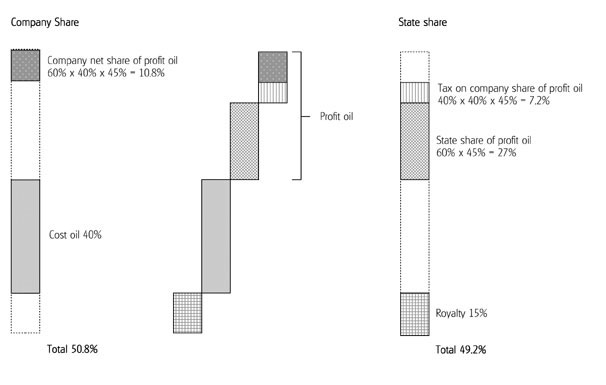 |
In the diagram above, we show how these
elements are divided. Royalties are charged as a percentage
of the total value of the oil. Cost oil is then deducted. In
this case, we assume that development and production costs
amount to 40% of the total revenue (this is determined by
the physical and economic characteristics of the oilfield,
rather than by the PSA terms). The remaining 45%, after
deducting royalties and cost oil, is divided between state
and company 60:40. The company’s share of profit oil is then
taxed.
Putting all of these together, the
company receives 50.2% of total revenues including the
recovery of its costs. As the profits of the field are 60%
of the revenues (after deducting the 40% costs) – thus the
state take is 82% of the profits; the company’s take (share
of profits) is 18%.
Sometimes the state also participates as
a commercial partner in the contract, operating in joint
venture with foreign oil companies as part of the consortium
(as in Libya, for example). In this case, the state is
considered as a shareholder in the ‘company’ – so the
‘company’ share of profit oil is split between the state and
private investors. If the state has a 50% participation
share, it provides 50% of the capital investment, and
receives a further 50% of the company share of profit oil
(after the state-company split).
A newer form of PSA divides ‘profit oil’
not in fixed proportions, but on a sliding scale, intended
to reflect the profitability of the venture.a The theory is
that the more profitable a venture, the quicker costs are
recovered, and so the more is available for the state. The
sliding scale can be based on rates of production
(90), ‘R’-factors
(defined as the ratio of cumulative receipts to cumulative
expenditures) or the company’s internal rate of return.(91)
The argument for rate-of-return style
PSAs is based on allowing the state to capture a reasonable
share of profits, but in practice this advantage can be
outweighed by other consequences:
1. the investor’s profits are effectively
guaranteed, by denying the state a fair share of revenue
until the specified profit has been achieved;
2. while the specified level of profits
is assured, this does not preclude the investor from
obtaining much higher profits (at the more normal, lower
share of profit oil);
3. it is in the investor’s interests to
inflate costs (a process known as ‘gold-plating’),
especially if they can sub-contract operations to another
company in the same group (for example, from one Shell
subsidiary to another Shell subsidiary) – as the
subcontractor profits from their work, the project operator
still profits according to the PSA, and the state gets
little or nothing.
Appendix 2: Discounting in
oilfield economics – key concepts
Back to top
THE TIME VALUE OF MONEY
Investments in the oil industry generally
last over a period of decades. A large amount of capital is
invested up-front, and then income is received over the life
of the project.
When modelling such investments, it is
important to consider the time value of money. A
specified amount of money is worth more now than it is at
some later date – even neglecting the effect of inflation.a
This is because money received now can be invested, and so
will earn extra profits.
For example, if I have £100 now, and
invest it in a bank account with 10% interest (0.1 in
decimals), I will get £10 interest in the first year. After
one year, I will have:
100 + (0.1 x 100) = 100 x 1.1 = 110.
In the second year, I will get £11
interest (10% of £110) – this includes interest on the
original £100, and also on the first year’s interest – known
as compound interest. After the second year I will
therefore have:
100 x 1.1 x 1.1 = £121.
Extending this logic, in five years’
time, I will have:
100 x 1.1 x 1.1 x 1.1 x 1.1 x 1.1 = £161.
This is written 100 x 1.15 (100 times 1.1
to the power of 5). Thus, if this level of interest is
available, £100 now is worth 61% more to me than £100 in
five years’ time.
DISCOUNTING AND PRESENT VALUE
Put the other way round, money is five
years’ time is worth less than it is now – to consider its
equivalent value today, we have to discount it.
When we compare different transactions at
different times, we discount all future amounts to what they
would be worth now, allowing for the time value of money.
What they would be worth now is called their present
value.
DISCOUNT RATE
The effect time has on the value of money
depends on what return would be available were the ‘now’
money to be invested. So if we could only get 5% interest,
£100 now would be worth 100 x 1.055 = £128 in five years’
time.
The annual rate at which today's money
would grow – and hence the rate at which ‘later’ money must
be discounted in our model – is called the discount rate.
Reversing the calculations above allows
us to work out present values. £100 in five years’ time has
a present value of:
100 / 1.055 = £78 at a discount rate of 5%; and
100 / 1.15 = £62 at a discount rate
of 10%.
The oil industry commonly uses a discount
rate of 12% in real terms, or 15% in nominal terms (allowing
for inflation).
The discount rate can be considered to be
the opportunity cost of capital. By investing capital in a
project, the investors have lost the opportunity to invest
it elsewhere. Therefore they will not invest in the project
if the capital could be invested elsewhere more profitably
(e.g. in another project, or in a bank account, or in bonds
or stocks). The discount rate is the return they would
expect to get by investing elsewhere.
NET PRESENT VALUE (NPV)
So when we consider the profitability of
a capital-intensive project such as an oilfield development,
we have to look at discounted values. Rather than simply
counting the profit as minus , we look at the net present value (NPV) of the project, which is
defined as [sum of present values of receipts] minus [sum of
present values of expenditures].
Net present value is always given with a
specified discount rate – if the discount rate is not
stated, the NPV is meaningless.
We can illustrate this with a simple
example of a five-year project, with the following cashflow:
|
Year
|
Expenditures
|
Receipts
|
|
1
|
75
|
0
|
|
2
|
20
|
30
|
|
3
|
10
|
40
|
|
4
|
10
|
40
|
|
5
|
10
|
40
|
This project has total expenditures of
125, and total receipts of 150. But to see whether it is
profitable, we need to use discounting.
|
Year
|
Net cash flow (NCF)
(= Receipts less expenditures) |
Present value of NCF
at 12% discount rate
|
|
1
|
-75
|
-75
|
|
2
|
10
|
= 10 / 1.12 = 8.93
|
|
3
|
30
|
= 30 / 1.122 = 23.92
|
|
4
|
30
|
= 30 / 1.123 = 21.35
|
|
5
|
30
|
= 30 / 1.124 = 19.07
|
This project has a net present value of £
-1.73, at a discount rate of 12% (the total of the
right-hand column) - so is not considered profitable.
Note that profitability depends on what
discount rate we use. At a discount rate of 10%, the same
project would have a net present value of £ +1.91 so it
becomes profitable at this discount rate.
INTERNAL RATE OF RETURN (IRR)
The other concept that is used to assess
profitability of oilfield projects is internal rate of
return (IRR). This is defined as the discount rate at
which the project NPV would be reduced to zero.
IRR can only be worked out numerically –
by trial and error. For the project above, we can see that
the IRR is somewhere between 10% and 12%. However, modern
spreadsheets programmes can calculate IRR automatically.
Using a spreadsheet, we can find that in fact the IRR for
this project is 11.03%.
The investor considers the project
profitable (and will decide to invest in it) if the IRR is
greater than the discount rate. The higher the IRR, the more
profitable the project.
Appendix 3: Iraqi oilfield
data
Back to top
As noted in section
4, Iraq’s emerging oil policy is that the Iraq National
Oil Company will continue to operate the oilfields which are
currently in production, while all new fields will be
developed by private companies through production sharing
agreements.
In March 1995, the Ministry of Oil (under
the Saddam regime) listed 25 new fields to be earmarked for
priority development if sanctions were lifted: 11 in the
south, 4 in central Iraq and 11 in the north. The list was
presented by Ministry officials including Thamer al-Ghadban,
who subsequently became “chief executive” of the Ministry
during the first few months of the occupation in 2003, and
then Oil Minister in the Interim government of Iyad Allawi.
These fields are listed below, with
summary data. This data has been taken from recent reports
by the US Department of Energy's Energy Information
Administration, Deutsche Bank, the Iraqi Ministry of Oil and
BearingPoint strategic consultants for the US Agency for
International Development (USAID).
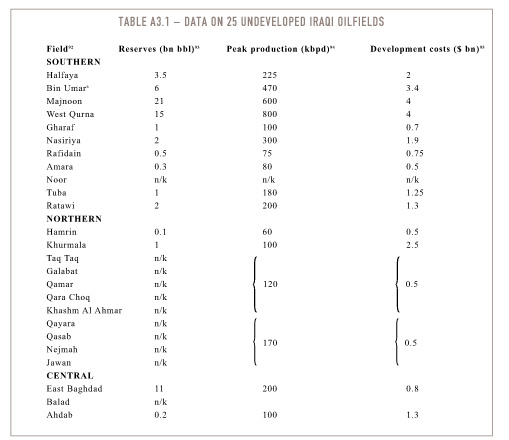
In June 2005, the Ministry of Oil
announced that it was seeking discussions with multinational
companies on the development of 11 oilfields in the south of
Iraq.(96) Although
they did not list the fields, we assume that it is the same
11 southern fields listed above.
The Khurmala and Hamrin fields in the
north are now being developed through technical service
agreements, signed respectively with Turkish company Avrasya
in December 2004 and with the Canadian OGI in March 2005,
leaving just 9 fields in the north, in two groups.
Appendix 4: Economic
analysis - methodology & assumptions
Back to top
The impact of the proposed Production
Sharing Agreement policy on Iraq’s revenue will of course
depend on the terms of any PSA, as well as on physical
circumstances, especially development and production costs,
and the oil price.
In this appendix we consider a number of
possible terms used in other countries, and apply them to a
‘base case’ physical scenario; we then test sensitivity to
variations in the physical scenario. The aim of the exercise
is to examine how PSA performance compares to the current
nationalised system.
Theoretically the state’s percentage of
net revenues from a PSA – known as state take – can range
anywhere from 0.1% to 99.9%, according to how the
contractual terms are set. In practice, according to
Petroconsultants’ 1995 review of petroleum fiscal regimes,
on economically marginal oil fields, state take ranges from
25.1% in Ireland to 101%2(m)
in Syria, while on very profitable ‘upside’ fields it ranged
from 25.0% in Ireland to 87.7% in Abu Dhabi. However most
PSAs provide for a state take of between 60 to 90%.
We have selected three different
scenarios (Oman, Libya and Russia)(n),
with varying terms, and then applied them to the physical
characteristics of Iraq’s oilfields, to consider their
economic implications.
Oman was selected as, like Iraq, it has
relatively low-cost onshore fields, and is one of the only
countries of the Gulf region that actually uses PSAs.
Libya was selected as it has produced oil for
many decades, and has recently reopened to foreign
investment following a period of international sanctions.
Libya’s most recent (“EPSA IV”) terms are widely considered
within the oil industry to be among the most stringent in
the world, so might be considered a ‘best case’ PSA for
Iraq.
Russia was selected as it is the only country
which currently uses PSAs and has oil reserves which are
remotely comparable in size to those of Iraq. Like Iraq,
Russia has had an oil industry for many decades. Russia's
PSAs were also signed during a period of rapid
liberalisation following major regime change. Indeed, there
is substantial technical collaboration between Russia and
Iraq.
PSA TERMS
Russia (Sakhalin II)
PSA terms for the Sakhalin II project in
Russia are as follow:(97)
$50m of bonuses; $160m reimbursement of state’s
exploration costs; $100m to Sakhalin Development Fund.
6% royalty.
No cost oil limit.
“Profit oil” split only once costs and 17.5% company IRR
have been achieved: 10:90 (government:company) for two
years, then 50:50 until 24% IRR achieved; then 70:30.
32% tax on company profits, for which capital costs are
depreciated over 3 years on a straight-line basis.
Oman
PSA terms for Oman are as follows:(98)
Signature bonus of $0.25m; discovery bonus of $3m;
production bonuses of $1m each when production levels of 25,
50, 75, 100, 125 and 150 kbpd are reached.
Cost oil limit of 40% of revenues.
Profit oil split 80:20.
No royalty.
No tax.
Libya (EPSA IV round)
Libya uses a modified joint venture-type
PSA. Terms for Libya's EPSA IV round are as follows:(99)
No tax (tax is paid only by the National Oil Company,
from its share of profit oil).
No royalty.
Signature bonuses and state participation share were
open for companies to bid in an auction, with the contract
going to whichever company offered the highest share of
production to the state (or whichever offered the higher
signature bonus if two companies bid the same share). State
participation shares of profit oil ranged from 61.1% to
89.2% (average 81.5%), and signature bonuses from $1m to
$25.6m (average $8.8m). In applying Libyan-type terms to
Iraqi oilfields, we take these average bonuses and
participation shares.
On top of the signature bonuses, further production
bonuses apply for each block. In our model, we take the
bonuses of Libya’s Block 54, which constitute: $5m when 100m
barrels have been produced, then a further $3m when each of
130, 160, 190, 220, 250,280, 310, 340 and 370 million
barrels have been produced.
State provides no contribution to exploration costs, 50%
of development capital, and share of operating costs equal
to its participation share.
Profit oil is split according to production rate and ‘R’
factor (ratio of contractor’s accumulated receipts to
accumulated costs). This varies from block to block in
Libya. For our analysis, we take the terms from Libya’s
Block 54, which does not consider production rate, but
divides profit oil according to ‘R’ factor as follows:
| ‘R’ factor |
Contractor share
|
| 0.0 - 1.5 |
90 |
| 1.5 - 3.0 |
70 |
| > 3.0 |
50 |
OIL FIELDS CONSIDERED
We now consider the economic impact on
Iraq, using these three sets of PSA terms.
For this assessment, we consider only the
fields likely to be opened soonest via PSAs: Halfaya, Bin
Umar, Majnoon, West Qurna, Gharaf, Nasiriya, Rafidain,
Amara, Tuba, Ratawi, East Baghdad and Ahdab. These are the
priority fields identified for development in 1995 (as
listed in Appendix 2), excluding Hamrin and Khurmala which
are now already being developed, and also excluding 11
smaller fields on which full data was not available.
PSAs could potentially be signed on all
of these in 2006.
ECONOMIC MODELLING
To consider the economic impact of the
proposed PSA policy, we have constructed economic models of
each of the twelve priority oil fields listed in
Appendix 3. The results are shown in
section 5.
We consider only oil, not gas, in this analysis.
All figures are in real terms (2006 prices) – i.e. with
no inflation.
We assume that economic factors (including production
rates, costs etc.) are the same whether oil is extracted by
the Iraq National Oil Company or by foreign companies
through PSAs. This assumption is based on the technical
expertise existing within Iraq’s own oil industry, and its
access to new technological resources through technical
service agreements.
We use a discount rate of 12%.
The analysis assumes PSAs are signed in 2006, followed
by feasibility and appraisal expenditures of $10 million in
the three subsequent years. Project sanction (and hence
first development investments) occur in 2009. First oil is
achieved in 2011, at 30% of the peak level, then rising
steadily to peak in 2014.
Production profiles are based on the figures for
reserves and peak production cited in Appendix 2, with
constant exponential declines in production ranging from 3%
for the largest fields (Majnoon, W Qurna, East Baghdad) to
15% for the smallest (Ahdab). Similarly, production plateaus
range from zero (single peak) for the small fields to over
20 years for the largest.
Development expenditures are based on those used by
PetroConsultants, adjusted according to the field size and
production rate, generally continuing until two years after
the end of peak/plateau production.
Iraqi oil experts estimate operating costs between $0.5(100)
and $1.5(101)
per barrel. We assume this to relate only to variable
operating costs; for our analysis, we take $1.0 per barrel.
We add fixed operating costs of 5% of development costs.
For simplicity, we do not include transport costs – thus
the oil price used is effectively the wellhead price. If
transport costs $0.5 per barrel, then the FOB oil price is
$0.5 higher than the wellhead price.
References
Back to top
(1) Letter to
Arthur Balfour, Foreign Secretary, 1918, cited in Daniel
Yergin, The Prize (Simon & Schuster, London, 1991), p.188
(2) Introductory
paper on the Middle East by the UK, undated [1947], FRUS,
1947, Vol. V, p. 569, cited in Mark Curtis, The Ambiguities
of Power (Zed Books, London, 1995), p. 21
(3) Memorandum by
the Chief of the Division of Near Eastern Affairs, undated
[1945], FRUS, 1945, Vol. VIII, p.45, cited in Mark Curtis,
The Ambiguities of Power (Zed Books, London, 1995), p. 21
(4) BP, Putting
energy in the spotlight, Statistical Review of World Energy,
June 2005
(5) Dick Cheney,
speech at the Institute of Petroleum Autumn lunch, London,
15 November 1999
(6) National
Energy Policy Development Group, National Energy Policy
report, May 2001, p.8-5
(7) Jack Straw,
Secretary of State for Foreign & Commonwealth Affairs,
speech on 'Strategic priorities for British foreign policy',
6 January 2003
(8) Ministry of
Defence, White Paper: Modern Forces for the Modern World
(Strategic Defence Review), July 1998, chapter 2, paragraph
40
(9) Foreign and
Commonwealth Office, UK International Priorities: A Strategy
for the FCO, December 2003
(10) US
Department of Commerce, Memorandum for the President,
Transmittal of the Report on the US-UK Energy Dialogue, 30
July 2003
(11) Ibid,
Section 1
(12) Ibid,
Section 1
(13) Foreign and
Commonwealth Office (FCO), Code of Practice for the Iraq Oil
Industry, undated (summer 2004), pp.4-5
(14) UK Secretary
of State for Foreign and Commonwealth Affairs, Government
Response to Seventh report of the House of Commons Foreign
Affairs Committee, on 'Foreign Policy Aspects of the War
Against Terrorism', September 2004
(15) Dr Kim
Howells MP, answer to Parliamentary Question by Harry Cohen
MP, 12 July 2005, Hansard column 878W
(16) James
McLaughlin (Iraq Policy Unit, Foreign & Commonwealth
Office), letter to Lorne Stockman (PLATFORM), response to
request under the Code of Practice on Access to Government
Information, 9 December 2004
(17) For more on
ongoing US influence in Iraq, see Herbert Docena, 'Shock and
Awe' Therapy, Focus on the Global South, April 2005
(18) Jim Krane,
"US will retain sovereign power in Iraq," Associated Press,
21March, 2004
(19) Bearing
Point, report to USAID, Options for Developing a Long Term
Sustainable Iraqi Oil Industry, 19 December 2003
(20) Eric
Watkins, 'Iraq seeks E&D investment, nixes reserves
privatization', Oil & Gas Journal, 16 February 2005
(21) Then the
Turkish Petroleum Company - renamed in 1928
(22) Daniel
Johnston, International petroleum fiscal systems and
production sharing contracts (Pennwell, 1994), p.39
(23) Thomas W
Wälde, 'The current status of international petroleum
investment: regulating, licensing, taxing and contracting',
in CEPMLP Journal, Vol 1, no.5, July 1995 (pub. University
of Dundee)
(24) Carola
Hoyos, 'Big players anticipate Iraq's return to fold',
Financial Times, 20 February, 2003
(25) Shell in the
Middle East magazine, April 2005, available online at
www.shell-me.com/english/apr05/news-me2.htm
(26) Glenn Irvine
International, recruitment advertisement, August 2004,
http://www.irvine-int.com/irqext.html#irqext. Luay Jawad
was appointed to the post
(27) Walter van
der Vijver, speech to ECSSR conference, 'A new era for
international oil companies in the Gulf: opportunities and
challenges', Abu Dhabi, 19 October 2003
(28)
International Tax & Investment Centre (ITIC), Strategic
Questions For Our Future, undated [2004]
www.iticnet.org/publications/StrategicQuestions.pdf
(29)
International Tax & Investment Centre (ITIC), Petroleum and
Iraq's Future: Fiscal Options and Challenges, Fall 2004, p.
3
(30) Ibid, p. 3
(31) Ibid, p.10
(32) BP, op cit,
p.4
(33) Marc
Grossman, Under Secretary for Political Affairs, Testimony
before the Senate Foreign Relations Committee, 11 February
2003; Eli J. Lake, 'US plans for post-Saddam Iraqi
government', The Washington Times, 5 June 2002.
(34) Nicolas
Pelham, 'Oil to be privatised but not just yet, says Iraqi
minister', Financial Times, 5 September 2003
(35) Carola
Hoyos, 'Exiles Call for Iraq to Let in Oil Companies',
Financial Times, 7 April 2003
(36) Ibid
(37) US State
Department, Future of Iraq Project, Oil and Energy Working
Group (Oil Policy Subgroup), April 2003, published in Middle
East Economic Survey, 'Iraqi oil policy recommendations
after regime change', 5 May 2003, pp.D1-D11
(38) Ibid
(39) Carola
Hoyos, op cit
(40) Philip J
Carroll, 'Personal commentary', in Oxford Energy Forum (pub
Oxford Institute for Energy Studies) November 2004
(41) Dr Kim
Howells MP, answer to Parliamentary Question by Harry Cohen
MP, 13 July 2005, Hansard column 1123W
(42) Nicolas
Pelham, op cit
(43) Ibid
(44) Thamer
al-Ghadban, interviewed by Bobby Schuck in Shell in the
Middle East magazine, October 2004
(45) Energy
Compass, 'Iraq: Puzzling over the future', 1 October 2004
(46) "For new
development of undeveloped oil and gas fields, and for
exploration, all of which must start as soon as possible and
in tandem with INOC's efforts, these should be accomplished
through private sector investment via competent
international … oil companies… However, these new ventures
should specifically not be allowed to partner with any
state-owned enterprises, including INOC, in order to ensure
state impartiality and avoid the pitfall of state
interference in corporate enterprise management". [Cited in
Middle East Economic Survey, 'Allawi outlines new Iraqi
petroleum policy: INOC for currently producing fields/IOCs
for new areas', 13 September 2004, pp. A1-A4]
(47) "Eventually,
in years to come, INOC may be partially privatised through
wide distribution of ownership among Iraqis through public
subscription" [ibid]
(48) "Should we
spend months and years trying to exact the last penny in
negotiating the commercial terms? I would suggest that there
is no need to waste time. Time is of the essence". [ibid]
(49) Dan Morgan
and David B. Ottaway, 'In Iraqi War Scenario, Oil Is Key
Issue', Washington Post, 15 September 2002, Page A01
(50) Text of the
draft Iraq Constitution, translated by Associated Press, 28
August 2005, article 110
(51) Ibid,
article 111
(52) Ibid,
article 108
(53) Embassy of
the United States, Baghdad, Ambassador Khalilzad statement
on the referendum results, October 26, 2005
(54) Christian
Schmollinger, 'Iraqi officials hopeful foreign oil firms
will return in 2006', International Oil Daily, 15 June 2005
(55) Glen Carey &
Faleh al-Khayat, 'Iraq looks to woo majors for field
revivals', Platts Oilgram News, 22 June 2005
(56) Heritage Oil
Corporation press release, 'Heritage Oil signs agreement for
Kurdistan, Iraq field study', 28 September 2005
(57) US
Department of Energy (US DOE), Energy Information
Administration, Iraq - Country Analysis Brief, June 2005,
www.eia.doe.gov/emeu/cabs/iraq.html
(58) Ibid
(59) Adil Abd
Al-Mahdi, Finance Minister, remarks at the National Press
Club, Washington DC, December 21, 2004
(60) Population
and economic data taken from US Central Intelligence Agency,
The World Factbook 2005
(61) ITIC,
Petroleum and Iraq's Future, op cit, p.17; FCO, Code of
Practice for the Iraq Oil Industry, op cit p.5
(62) ITIC,
Petroleum and Iraq's Future, op cit, Annex 3, pp. 64-70
(63) Like many of
the other details of the contracts, the extent to which this
is a problem will depend on the outcome of negotiations.
However, experience elsewhere suggests it will be difficult.
For example, OPEC members Algeria and Nigeria have
consistently struggled, and largely failed, to rein in
foreign companies' production rates. Of the 11 members of
OPEC, these two (along with Indonesia, which has recently
under-produced its quota anyway, due to declining capacity)
are the ones with the greatest level of foreign oil company
involvement. Similarly, when Iraq under Saddam Hussein
attempted to attract foreign investment in 1995, the Oil
Minister admitted in an interview with Middle East Economic
Survey that guarantees would have to be given to oil
companies that they would be able to produce at their
desired level. [Dr Safa Hadi Jawad al_Habubi, interview with
MEES, 38:25, 20 March 1995, p.A5]
(64) E.g. in
Azerbaijan's ACG PSA [Article XXIII, clause 23.2]: "In the
event that the Government or other Azerbaijan authority
invokes any present or future law, treaty, intergovernmental
agreement, decree or administrative order which contravenes
the provisions of this Contract or adversely or positively
affects the rights or interests of Contractor hereunder,
including, but not limited to, any changes in tax
legislation, regulations, administrative practice, or
jurisdictional changes pertaining to the Contract Area the
terms of this Contract shall be adjusted to re-establish the
economic equilibrium of the Parties, and if the rights or
interests of Contractor have been adversely affected, then
SOCAR shall indemnify the Contractor (and its assignees) for
any disbenefit, deterioration in economic circumstances,
loss or damages that ensue therefrom."
In the PSA for Shell's Sakhalin II oil
developments in Russia, Appendix E exempts the project from,
amongst other laws, the Russia Water Code which forbids
discharge of flows and drainage waters in spawning and
wintering areas for valuable and protected fish species and
in habitat for Red Book protected wildlife and plant
species. Destruction of salmon spawning sites as a result of
oil spillage is a major concern in the project. Article 24
(f) also provides blanket compensation for damage caused to
Shell's profits: The Russian Party shall compensate the
Company for any damage caused to the consortium's
"commercial position" by "adverse changes in Russian laws,
subordinate laws and other acts taken by Government bodies
after December 31, 1993 (including changes in their
interpretation or their application procedure by government
bodies and by the courts in the Russian Federation)."
(65) Susan
Leubuscher, 'The privatisation of justice: international
commercial arbitration and the redefinition of the state'.
MRes thesis, Birkbeck College, 2 June 2003
www.fern.org/pubs/reports/dispute%20resolution%20essay.pdf
(66) Nino
Chkhobadze (Georgian Minister for the Environment), letter
to BP CEO John Browne, 26 November 2002; AFP, 'Georgia
approves $2.9bn oil pipeline', 2 December 2002
(67) “We won’t be
bullied”, Transitions Online, 9 August 2004
(68) Helmut
Merklein, 'Who needs big oil in Iraq: The case for going it
alone', Middle East Economic Survey, 12 January 2004
(69) ITIC,
Petroleum and Iraq's Future, op cit, p.33
(70) Ibid, p.8
(71) Bearing
Point, op cit, p.5
(72) Dunia
Chalabi (International Energy Agency), 'Perspective for
Investment in the Middle East/North Africa Region',
Presentation to the OECD, Istanbul, 11-12 February 2004, p.7
(73) BP, op cit,
p.4
(74) Putting
energy in the spotlight - BP Statistical Review of World
Energy June 2005
(75) Oil Ministry
figures give an investment requirement of $25 billion over
ten years. In our economic models, the investment peaks at
$3.0 bn in 2012 (the fourth year of development). However,
in the models first oil is expected in 2011 - thus this will
contribute to the 2012 investment. The highest annual net
investment in the models is $2.3 billion, in 2011.
(76)
International Oil Daily, 'Iraqi Oil Ministry Gets Big Leap
in Funds', 26 October 2004
(77) FCO, Code of
Practice, op cit p.4
(78) Helmut
Merklein, op cit. In this comment, Dr Merklein is actually
referring to the smaller cost of rehabilitating production
to pre-Gulf War levels; but the same applies to the larger
investment too
(79) Dr Muhammad
Ali Zainy (Energy Economist and Analyst, Centre for Global
Energy Studies), at the 10th Annual Energy Conference of The
Emirates Center for Strategic Studies and Research (ECSSR),
26-27 September 2004, Abu Dhabi, UAE, reproduced in Middle
East Economic Survey, 47:42, 'Iraq's Oil Sector: Scenarios
For The Future', 18 October 2004
(80)
www.jubileeiraq.org
(81) See e.g.
Justin Alexander, 'Saddam's Odious Debt', Swans Commentary,
2 February 2004,
www.swans.com/library/art10/iraq/alexander.html
Also The Economist, 'Those odious debts',
18 October 2003: "The Iraqi debt problem highlights a huge
unresolved flaw in the international financial system. There
is an overwhelming case, both in terms of economic
expediency and justice, for writing off most of Iraq's
debts, and doing so fast… It is clearly unfair to expect the
Iraqi people to pay for the reckless waste of the regime
that brutally oppressed them for so long."
(82) Wall Street
Journal, editorial, 30 April 2003, quoted in Jubilee Iraq,
'Saddam's Odious Debt - Iraqis address the Paris Club',
November 2004
(83) See for
example, ITIC, Petroleum and Iraq's Future, op cit, p.6;
FCO, Code of Practice, op cit p.5; Iyad Allawi guidelines on
oil policy, reported in Middle East Economic Survey, 47:37,
13 September 2004, p.A2.
(84) For example,
ITIC, Petroleum and Iraq's Future (op cit), pp.30-31: "For
the most part, international oil companies do not favor risk
service contracts. Such contracts have sometimes been
accepted as an interim measure, or a cost of access, on the
route towards eventual creation of a PSA regime. Typically
risk service contracts offer relatively low returns and
present difficulties for companies in booking reserves."
ITIC indicates reluctant acceptance of development and
production contracts, but indicates a strong preference for
PSAs
(85) Ed Harriman,
'Where has all the money gone?', London Review of Books,
Vol. 27 No. 13 7 July 2005; Iraq Revenue Watch, 'Audits find
more irregularities and mismanagement of Iraq's revenues',
December 2004
(86) Iraq Revenue
Watch, Protecting the Future: Constitutional Safeguards for
Iraq's Oil Reserves, Report No.8, May 2005
(87) Publish What
You Pay objectives -
http://pwyp.gn.apc.org/english/objectives/
(88) Iraq Revenue
Watch, Protecting the Future, op cit
(89) See e.g.
Striking a Better Balance: The World Bank Group and
Extractive Industries, Final Report of the Extractive
Industries Review Vol 1, pp.12-16 and 45-52
(90) For example,
in Syria the state's share of profit oil ranges from 79% for
fields producing less than 50,000 barrels per day, to 87.5%
for fields producing more than 200,000 barrels per day.
(91) For example,
in the Azeri-Chirag-Guneshli PSA, the Azerbaijan state only
gets 30% of the profit oil until the BP-led consortium has
achieved 16.75% rate of return - a comfortable level of
profits. After that, the state's share goes up to 55%. Only
after the consortium has achieved a 22.75% rate of return -
a high level of profits - does the state's share of profit
oil go up to a more normal 80%. [ACG PSA, article XI, clause
11.6]
The Sakhalin II PSA goes even further. In
that case, the Russian state gets no profit oil until the
Shell-led consortium has achieved 17.5% rate of return. The
state then receives just 10% for a further two years, and
then 50% until the consortium has obtained 24% rate of
return, after which the state receives 70%. [Sakhalin II
PSA, section 14. For detailed analysis, see Ian Rutledge,
'The Sakhalin II PSA - A production non-sharing agreement'
(pub CEE Bankwatch Network, PLATFORM, Friends of the Earth,
Sakhalin Environment Watch, Pacific Environment, WWF),
November 2004]
(92) Some of
these fields are producing small amounts of oil, including
Majnoon, West Qurna and East Baghdad. However, their
production is well below their potential, respectively
50,000, 250,000 and 20,000 barrels per day prior to the
March 2003 invasion [US DOE, op cit] - essentially amounting
to minor development of small parts of the fields. As such,
they are commonly described as "undeveloped". [See e.g.
Mohammad Al-Gailani (MD, GeoDesign Ltd), 'Assessing Iraq's
oil potential', Geotimes, October 2003]
(93) Reserves
figures are taken from Deutsche Bank, Baghdad Bazaar - Big
Oil in Iraq?, 21 October 2002, p.12; and from US DOE, op cit
(94) Peak
production figures are taken from al-Ghadban et al (Iraq
Ministry of Oil), paper presented at seminar on 'The future
of oil and gas markets', Baghdad, 11-12 March 1995,
reproduced in Middle East Economic Survey, 38:25, 20 March
1995, pp.D1-D15; Deutsche Bank, op cit; and Bearing Point,
op cit
(95) Development
cost data is taken from Deutsche Bank, op cit; Bearing
Point, op cit; except Gharaf field, which is taken from
average of 7,000 per daily barrel, cited in al-Ghadban et
al, op cit
(96) Glen Carey &
Faleh al-Khayat, op cit
(97) For detailed
analysis, see Ian Rutledge, op cit
(98) From
PetroConsultants, Annual Review of Petroleum Fiscal Regimes,
1995
(99) For detailed
analysis, see Daniel Johnston5, 'Impressive Libya licensing
round contained tough terms, no surprises', in Oil and Gas
Journal, 18 April 200, pp.29-37
(100) E.g. Dr
Muhammad-Ali Zainy, op cit
(101) E.g.
Fadhil Chalabi (former OPEC Deputy Secretary-General and
Iraq Oil Ministry official, now of Centre for Global Energy
Studies), quoted in Carola Hoyos, 'Big players anticipate
Iraq's return to fold', Financial Times, 20 February 2003
(a)In the USA,
onshore reserves belong to the landowner, which may be a
public or private body or individual
(b) The last
remnants of concessions were nationalised in 1975.
(c) During the
final years of Saddam Hussein's regime, Iraq tried to
re-open its oil industry to foreign capital. This process
was highly political, and contracts were negotiated with and
awarded primarily to companies from UN Security Council
member countries Russia, China and France, in an attempt to
win support for the dropping of UN sanctions. A PSA deal was
actually signed in 1997 - with Russian company Lukoil for
the West Qurna field - but never implemented, due to the
sanctions. Ultimately, Saddam cancelled the contract.
Disputes still continue with the new Iraqi authorities as to
whether this contract has any validity. Saddam also signed a
development and production contract (DPC) with China
National Petroleum Corporation for the al-Ahdab field (also
never implemented, and ultimately frozen), and came very
close to signing a PSA deal with French company Total, on
the Majnoon field. Negotiations also took place on various
other fields for PSAs, buybacks or DPCs (see
section 6).
(d) Bob Morgan
died as a result of a rocket attack on his car in Baghdad,
in May 2004
(e) In this,
Allawi was being highly unrealistic. Although contracts can
allow a certain degree of renegotiation, companies will not
sign them if the potential for renegotiation is substantive
or meaningful.
(f) Following the
agreement on a Constitution, a Petroleum Law is the next
step in defining how the oil industry is to be run.
(g)We also ran the
models with the terms used in PSAs Qurna field in 1997
(which was never implemented, outlined here.
(h) Of these, we
were unable to obtain full data on 11 fields projected
production (and hence revenue).
(j) This omission
compounds the inaccuracy of ITIC’s assumption barrels per
day – on this point, see the section 6.
(k) We have used a
12% discount rate, as the rate most commonly used in the oil
industry. However, it should be noted there is some debate
among development economists as to what discount rate should
be used for public sector investments. It is commonly argued
that, since states can borrow capital at lower interest
rates than private companies, and since states do not invest
in the same way as companies (and so do not experience the
same extent of opportunity costs), the discount rate should
be lower than for private sector investments. For example,
US public institutions use a discount rate of 7%. Some
economists even argue that states should apply a zero
discount rate, as the process of discounting undervalues
expenditure for future generations. A lower discount rate
would mean a higher NPV loss to the Iraqi state.
(l) See for
example, the 'Drilling into debt' report by Oil Change
International, which finds that oil-producing countries tend
to experience major indebtedness.
(m)These figures
are produced by applying all the countries’ terms to the
same hypothetical oilfields. Clearly, the marginal field
here would not be developed if found in Syria, as it would
be uneconomic – the company would make a net loss.
(n) We noted in
section 6 that no countries comparable to Iraq use PSAs –
indeed we would argue that PSAs are not appropriate to
Iraq’s situation of plentiful, low-cost, known fields. Thus
there is no natural choice of country’s terms to apply in
this analysis. Therefore it should be noted that the Oman
and Libya PSAs are for exploration and production, and thus
carry the exploration risk that no oil will be found. As a
result they give potentially more lucrative terms to
compensate for the risk of failure to find oil. The short-
and medium-term development of Iraq’s oil will be of the
roughly 65 known but undeveloped fields, whereas new
exploration (especially in the Western Desert) will deliver
longer-term development. However, against the lack of
exploration risk in potential early PSA contracts, Iraq
carries more political risk than any of these other cases.
On the other hand the Sakhalin II field (which like the
Iraqi fields was known before the PSA was signed) is
offshore and hence higher-cost which may be reflected in
more lucrative terms for the company. However, the current
high political risk in Iraq could quite plausibly lead to
similarly lucrative terms.
The exception would be the PSA deal
signed by Saddam Hussein with Lukoil in 1997 for the West
Qurna field which was never implemented and was cancelled in
2002. We have not used these terms as one of our three
featured scenarios because of its unusual status. However,
we did test the model against those terms. The loss of state
revenue (undiscounted and NPV) is within the range of these
three scenarios. The company internal rates of return,
remain high by international oil industry standards (20%,
40%, 57% at $40/barrel) for the 3 fields we examined in
section 5) but at lower than the three featured scenarios
due to an unusually high $100 million up-front signature
bonus. While the bonus is small compared to the total value
of revenue, the fact that it is paid up-front impacts more
significantly on the rate of return (due to the time value
of money - see Appendix 2). The context of this decision was
that it was signed during the sanctions era, when the regime
was desperate for up-front cash, but conversely keen to win
Russia's political support in the UN Security Council. In
this sense it was not a 'normal' PSA so we have not used it
in our main analysis. The Lukoil terms were not officially
published, so in our test we used those reported by the
Middle East Economic Survey [11 November 2004 - 'Lukoil
Seeks West Qurna Development/Iraq Debt Deal'].
About the publishers
Back to top
Lead publisher
PLATFORM is an interdisciplinary
organisation working on issues of environmental and social
justice. Founded in 1984, it specialises in addressing the
impacts of British oil corporations on development,
environment and human rights.
www.carbonweb.org
US co-publishers
Global Policy Forum monitors policy
making at the United Nations, promotes accountability of
global decisions, educates and mobilizes for global citizen
participation, and advocates on vital issues of
international peace and justice.
www.globalpolicy.org
The Institute for Policy Studies
strengthens social movements with independent research,
visionary thinking, and links to the grassroots, scholars
and elected officials. With an emphasis on the UN and the
Middle East, IPS's New Internationalism Project works to
strengthen the US and global peace movements.
www.ips-dc.org
Oil Change International campaigns to
expose the true costs of oil and facilitate the coming
transition towards clean energy. We are dedicated to
identifying and overcoming political barriers to that
transition.
www.priceofoil.org
UK co-publishers
The New Economics Foundation (NEF) works
to construct a new economy centred on people and the
environment. Founded in 1986, it is now one of Britain’s
most creative and effective independent think tanks,
combining research, policy, training and practical action.
www.neweconomics.org
War on Want is a UK-based campaigning
charity. Founded in 1951 it has links to the labour movement
and supports progressive, people-centred development
projects around the world. War on Want campaigns in the UK
against the causes of world poverty.
www.waronwant.org
|